

Dear Readers, Welcome to Deep Research Global.
Let’s analyze the topic in detail.
Executive TL;DR
AMD delivered record FY2025 revenue of $34.6 billion (up 34% year over year), then opened FY2026 with a Q1 print of $10.3 billion, up 38% year over year, driven by EPYC servers and Instinct GPUs.
A 6 gigawatt OpenAI agreement (October 2025) plus a 6 gigawatt Meta deployment (February 2026) anchor a multi-year AI accelerator pipeline starting with MI450 in 2H 2026.
Data Center segment revenue hit $5.78 billion in Q1 2026, up 57% year over year, with EPYC server CPUs commanding 46.2% revenue share of the server market.
China export restrictions cut roughly $1.5 to $1.8 billion from 2025 revenue, but the partial easing in 2H 2025 and Helios rack-scale platform in 2H 2026 reset the growth trajectory.
Recommended - Read Full Reports


Read All Reports
Table of Contents
Executive TL;DR
Introduction
AMD Company Profile: Key Facts Snapshot
AMD Investment Thesis
Pillar 1: The Server CPU Cash Machine
Pillar 2: A Credible Second AI Compute Vendor
Pillar 3: Adaptive Computing Optionality
AMD Business Model Overview
Revenue Recognition and Customer Concentration
Operating Expense Structure
AMD Revenue Analysis
Quarterly Revenue Trajectory
Geographic Revenue Mix
AMD Latest Quarterly Earnings, Guidance, Margins, and Earnings Quality
Q1 2026 Headline Metrics
Gross Margin Mechanics
Earnings Quality
EPS Trajectory
AMD Cash Flow Mechanics
Operating Cash Flow
Capital Expenditures
Capital Returns
AMD Balance Sheet Health
AMD Segment-by-Segment Teardown
Data Center Segment
EPYC Server CPUs
Instinct AI Accelerators
Pensando DPUs
Client and Gaming Segment
Ryzen Desktop and Mobile
Radeon Discrete Graphics
Semi-Custom Consoles
Embedded Segment
FPGA and Adaptive SoC Portfolio
EPYC Embedded
Major AMD Competitors
AMD vs. NVIDIA
Key Comparison Metrics
AMD vs. Intel
AMD vs. Broadcom (ASIC Threat)
AMD vs. Apple, Qualcomm (Client Threat)
AMD Strategic Context
From Chips to Rack-Scale Systems
The ROCm Open Stack Bet
M&A Posture
Talent and R&D Allocation
AMD Valuation Framework
Valuation Multiples Snapshot
What the Multiple Implies
Scenario-Weighted Sum-of-the-Parts
AMD Bull, Base, and Bear Case Scenario Analysis
Bull Case
Base Case
Bear Case
Key Risks for AMD
Risk 1
Risk 2
Risk 3
Risk 4
Risk 5
Risk 6
Risk 7
Risk 8
Risk 9
Risk 10
Catalysts to Watch
Catalyst 1
Catalyst 2
Catalyst 3
Catalyst 4
Catalyst 5
Catalyst 6
Catalyst 7
My Final Thoughts
Latest Analyst Price Targets
Official Sources and Data
Disclaimer: This analysis is for informational & educational purposes only and should not be construed as investment advice. Investors should conduct their own due diligence and consult with their personal financial advisors before making investment decisions. Past performance does not guarantee future results.
Introduction
AMD is no longer “the other x86 company.”
It’s now a credible second source for trillion-parameter AI training infrastructure, the leading server CPU vendor by revenue, and a profitable adaptive-computing player.
The combination, which sat dormant for years after the Xilinx close, finally clicked in 2025 and accelerated into 2026.
This in-depth analysis report walks through the numbers, the segments, the partners, the silicon, and the risks.
For investors, the central question is whether the AI win streak that produced the OpenAI and Meta deals is durable, or whether NVIDIA’s CUDA moat and the export-control overhang will keep AMD’s earnings power capped.
AMD Company Profile: Key Facts Snapshot
Advanced Micro Devices, Inc. designs high-performance and adaptive computing silicon. The company is headquartered in Santa Clara, California, employs roughly 28,000 people, and trades on NASDAQ under the ticker AMD.
The current product portfolio spans data-center CPUs (EPYC), data-center accelerators (Instinct), client CPUs (Ryzen), discrete and integrated graphics (Radeon), semi-custom SoCs for game consoles, FPGAs and adaptive SoCs (Versal, Kintex, Virtex from the Xilinx acquisition), DPUs (Pensando), and AI engines (Ryzen AI, XDNA).
Dr. Lisa Su has served as Chair and CEO since 2014, and Jean Hu has served as EVP, CFO and treasurer since 2023. Dr. Mark Papermaster is the long-tenured Chief Technology Officer.
Ticker:               AMD (NASDAQ)
HQ:                   Santa Clara, California
Founded:              May 1, 1969
Employees:            ~28,000
FY2025 Revenue:       $34.6 billion (+34% YoY)
FY2025 Net Income:    $4.3 billion
FY2025 Gross Margin:  50%
Q1 2026 Revenue:      $10.3 billion (+38% YoY)
Market Cap (May 22):  ~$762 billion
CEO:                  Dr. Lisa Su
CFO:                  Jean Hu
Fiscal Year End:      Last Saturday in December
The company’s transformation since the Zen architecture launched in 2017 has been one of the most consequential in semiconductors, and the most recent two-year period has shifted the narrative again from “the Intel-of-x86” challenger to “the second AI compute pillar.”
AMD Investment Thesis
The bull case for AMD rests on three pillars:
An entrenched server CPU franchise that prints cash,
A credible AI accelerator alternative to NVIDIA with multi-gigawatt off-take agreements, and
An adaptive-computing arm that monetizes long-cycle markets in aerospace, defense, automotive, and industrial.
Each pillar matters individually, and together they smooth what has historically been a brutally cyclical semiconductor profile.
Pillar One: The Server CPU Cash Machine
EPYC has crossed a milestone that even AMD’s most optimistic supporters were uncertain about.
In Q1 2026, EPYC captured a record 46.2% server revenue share, eclipsing the previous all-time high of 41.3% set in Q4 2025. That is a structural shift, not a cyclical fluke, because hyperscaler buying decisions reflect multi-year capacity planning and validated workloads.
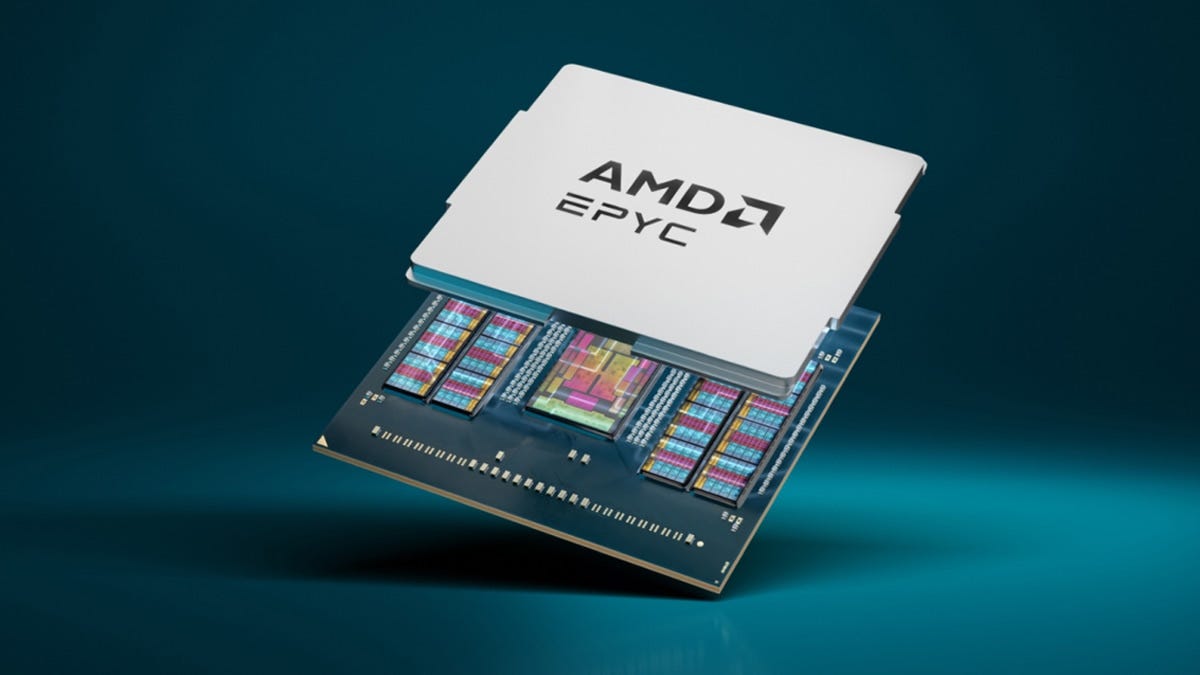
The platform monetization is improving as well. The fifth-generation EPYC 9005 “Turin” family scales to 192 Zen 5c cores on a single socket, and the sixth-generation “Venice” parts are sampling on TSMC N2 with up to 256 Zen 6 cores.
Density of this magnitude translates into rack consolidation savings that hyperscalers cannot ignore.
Pillar Two: A Credible Second AI Compute Vendor
The October 2025 OpenAI agreement is a strategic re-pricing event.

OpenAI committed to deploying 6 gigawatts of Instinct GPUs across multiple generations, with the first 1 GW going live in 2H 2026 on MI450 silicon. AMD issued OpenAI a warrant for up to 160 million shares, structured to vest as gigawatt milestones are achieved.
Meta then signed its own 6 gigawatt agreement in February 2026, pairing custom MI450-derived GPUs with sixth-generation EPYC “Venice” CPUs.

Combined, the two anchor customers represent a level of secured demand that AMD’s accelerator business has never enjoyed.
Pillar Three: Adaptive Computing Optionality
The embedded segment, mostly the legacy Xilinx franchise, posted $3.5 billion in 2025 revenue, down 3% year over year as customers worked through inventory.
The segment returned to growth in Q1 2026 with $873 million in revenue, up 6%, and operating margins on this business consistently exceed 35%.
These are sticky, design-win-driven revenue streams in aerospace, test and measurement, medical imaging, and broadcast. They cushion the cyclicality of consumer and gaming, which makes the consolidated earnings profile more bond-like over time.
INVESTMENT THESIS PILLARS - Q1 2026 SNAPSHOT
--------------------------------------------
Pillar 1: EPYC Server CPUs
  - 46.2% server CPU revenue share
  - $5.78B Data Center revenue (+57% YoY)
  - 27.7% operating margin

Pillar 2: Instinct AI Accelerators
  - 6 GW OpenAI deal (warrant for 160M shares)
  - 6 GW Meta deal (custom MI450 derivative)
  - MI450 ships 2H 2026, Helios rack 2H 2026

Pillar 3: Adaptive Computing (Embedded)
  - $873M Q1 2026 revenue (+6% YoY)
  - 38.7% Q1 2026 segment operating margin
- Long-cycle design wins, low cyclicalityAMD Business Model Overview
AMD is a fabless semiconductor designer.
It owns the architecture, the IP, and the software stack. It outsources wafer fabrication to TSMC, with leading-edge nodes (N5, N4P, N3, N2) running for CPU and GPU dies.
Back-end advanced packaging uses TSMC CoWoS and SoIC, with substrate and HBM supply chains running through Samsung, SK hynix, and Micron.
This structure delivers high incremental gross margins, capital efficiency, and the ability to scale revenue much faster than an integrated device manufacturer.
The trade-off is supply-chain concentration: TSMC’s capacity allocation directly governs how fast Instinct units can ramp.


Revenue Recognition and Customer Concentration
AMD recognizes revenue when control of products transfers to the customer, generally at shipment.
Top customers for FY2025 included Microsoft, Dell, Hewlett Packard Enterprise, Lenovo, Sony, and the hyperscale cloud operators. Two customers each individually represented more than 10% of consolidated revenue in 2025, per the latest 10-K filing.
That concentration is rising as the OpenAI and Meta agreements ramp, which is both a strength (visibility) and a risk (single-customer churn).
Operating Expense Structure
R&D was $8.09 billion in 2025, up 25.3% year over year, reflecting heavy investment in MI400-series CDNA Next, EPYC Venice and Verano, and ROCm software. SG&A expansion has been comparatively muted, which is why operating leverage is now visible.
The bigger expense story is capital allocation: AMD has chosen to spend on engineering talent (the ZT Systems acquisition added roughly 1,000 systems engineers) rather than on capacity, leaving wafer commitments and HBM purchases as the variable cost base.
AMD Revenue Analysis
The headline story for FY2025 is straightforward. Revenue grew from $25.8 billion in FY2024 to a record $34.6 billion in FY2025, a 34% increase.
That growth was overwhelmingly powered by