

Arm Holdings plc $ARM ( ▲ 11.27% ) is a British semiconductor and software design company whose chip architectures power approximately 99% of the world’s smartphones and an expanding portfolio of data center, automotive, and Internet-of-Things (IoT) devices.
With a market capitalization of $164 billion, Arm’s strategic positioning in the AI era warrants careful examination by investors seeking to understand the semiconductor sector’s future trajectory.
Our analysis examines Arm’s competitive positioning through a comprehensive SWOT framework, as it navigates the semiconductor industry’s most dynamic period in decades.
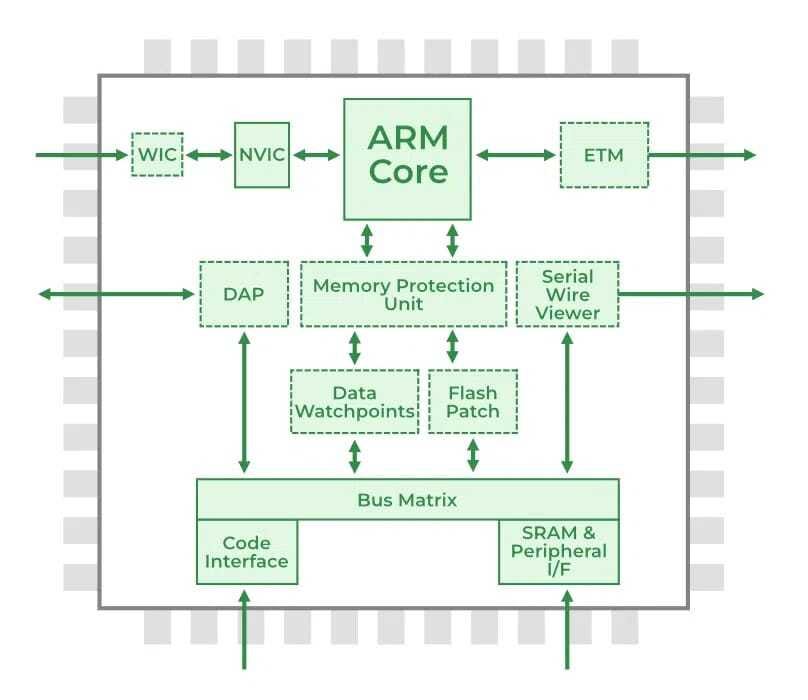
Image source: geeksforgeeks.org
Company Overview and Business Model
Arm Holdings operates under a distinctive business model that differentiates it from traditional semiconductor manufacturers. Rather than producing physical chips, Arm designs and licenses intellectual property for chip architectures that other companies use to manufacture processors.
This asset-light approach generates revenue through two primary channels: licensing fees paid upfront by chipmakers to access Arm’s designs, and ongoing royalties collected for each chip manufactured using Arm technology.
According to financial reports published in November 2025, Arm’s second-quarter fiscal 2026 revenue reached $1.14 billion, representing a 34% year-over-year increase. Royalty revenue contributed $620 million to this total, growing 21% annually, while licensing revenue reached $515 million with a 56% year-over-year surge. The company’s gross profit margin stands at an impressive 97.14%, reflecting the high-margin nature of intellectual property licensing.
SoftBank Group maintains approximately 87% to 90% ownership of Arm Holdings following the company’s September 2023 initial public offering, which raised $4.87 billion while offloading less than 10% of SoftBank’s stake. This concentrated ownership structure provides strategic stability but also influences corporate governance dynamics.
Strengths: Dominant Market Position and Technical Excellence
Unparalleled Mobile Market Dominance
Arm’s most formidable strength lies in its near-monopoly position within smartphone processors.
The company’s technology powers over 99% of the world’s smartphones, establishing an entrenched competitive moat that competitors find extraordinarily difficult to penetrate. This dominance stems from decades of optimization focused on power efficiency rather than raw computational performance, making Arm architectures ideally suited for battery-powered mobile devices.
Major smartphone manufacturers including Apple, Samsung, Qualcomm, and MediaTek all rely on Arm’s chip designs for their flagship devices. Apple’s custom-designed processors for iPhones and iPads, Samsung’s Exynos chips, and Qualcomm’s Snapdragon platform all utilize Arm architecture as their foundation.
This ubiquity creates powerful network effects: software developers optimize applications for Arm processors because of their market dominance, which in turn reinforces manufacturers’ preference for Arm designs.
www.deepresearchglobal.com/p/apple-swot-analysis
Qualcomm - SWOT Analysis Report (2026)
www.deepresearchglobal.com/p/qualcomm-swot-analysis-report
High-Margin Revenue Model
The intellectual property licensing model generates exceptional profitability metrics. With gross margins exceeding 97%, Arm captures substantial value from each technology license and royalty payment without incurring the capital-intensive costs associated with semiconductor fabrication. This capital efficiency allows Arm to invest heavily in research and development while maintaining strong cash flow generation.
The licensing structure provides predictable recurring revenue streams. Once chipmakers integrate Arm designs into their product development cycles, switching costs become prohibitively high due to the extensive software ecosystems built around specific chip architectures.
This creates customer stickiness that stabilizes long-term revenue projections.
Advanced v9 Architecture and CSS Adoption
Arm’s latest Armv9 architecture represents a significant technological advancement, commanding higher royalty rates than previous generations.
According to company disclosures, v9-based cores now account for more than 30% of royalty revenue, up from approximately 25% in earlier quarters. This architectural evolution enables enhanced AI capabilities, improved security features, and superior performance efficiency.
Armv9 Architecture Key Advantages:

• Enhanced AI/ML Performance: Specialized instructions for AI workloads
• Improved Security: Confidential Compute Architecture (CCA) for data protection
• Scalable Vector Extension 2 (SVE2): Advanced vector processing capabilities
• Higher Royalty Rates: Premium pricing reflecting advanced capabilities
• Cross-Platform Consistency: Unified architecture from mobile to data center
Complementing the v9 architecture, Arm’s Compute Subsystems (CSS) offerings provide pre-integrated, production-ready chip implementations that accelerate time-to-market for customers. CSS licenses generate approximately double the royalty rates of standalone v9 designs.
By the second quarter of FY2026, Arm had signed 19 CSS licenses with 11 companies, with five customers already shipping CSS-based chips. Samsung’s decision to leverage CSS for its Exynos chipset family means the top four Android phone vendors now ship CSS-powered devices.
Expanding Data Center Presence
Arm’s aggressive expansion into data centers represents a strategic inflection point. The company projects that Arm-based processors will power approximately 50% of new hyperscaler CPU installations in 2025, marking dramatic growth from about 15% market share earlier in the year. This surge reflects data center operators’ prioritization of power efficiency and total cost of ownership as AI workloads proliferate.
Major cloud infrastructure providers have embraced Arm architecture:
Cloud Provider
Arm Implementation
Status
Amazon Web Services
Graviton processors
Production deployment across multiple services
Google Cloud
Axion processors
Migrating 30,000+ applications to Arm, targeting 100,000 total
Microsoft Azure
Cobalt 100 processors
Expanded to 29 global regions
Nvidia
Grace CPU / Grace Blackwell
Over $500 billion in expected orders through 2026
Oracle
Ampere Altra
Available across cloud regions
Google’s commitment to migrate most of its 100,000 applications to Arm-based infrastructure demonstrates the architecture’s viability for large-scale cloud operations. This migration encompasses critical services including Gmail and YouTube, validating Arm’s performance and reliability for demanding workloads.
www.deepresearchglobal.com/p/amazon-swot-analysis

www.deepresearchglobal.com/p/alphabet-swot-analysis

Microsoft SWOT Analysis (2025)
www.deepresearchglobal.com/p/microsoft-swot-analysis

www.deepresearchglobal.com/p/nvidia-swot-analysis

Robust Developer Ecosystem
Arm’s developer ecosystem exceeds 22 million developers, representing more than 80% of the global developer population. This extensive community creates self-reinforcing advantages: abundant software libraries, frameworks, and tools reduce development friction for companies adopting Arm architecture, while the large addressable market incentivizes developers to prioritize Arm compatibility in their projects.
Recent ecosystem initiatives include integration with GitHub Copilot, enabling automated cloud workload migration to Arm-based infrastructure. The Arm KleidiAI software framework delivers up to 2.5x faster performance on transformer-based models in PyTorch, improving on-device AI processing speed and energy efficiency by over 20%.
Strategic Partnerships and Customer Relationships
Arm has cultivated deep partnerships with technology industry leaders. The October 2025 strategic partnership with Meta exemplifies Arm’s comprehensive platform approach, spanning AI-enabled wearables to data center infrastructure. Meta’s recommendation engines powering Facebook and Instagram run on Arm Neoverse CPU cores, while the company’s AI-capable smart glasses utilize Arm technology.
The November 2025 partnership with Nvidia integrating NVLink Fusion technology into Arm’s Neoverse platform represents another significant milestone. This collaboration enables high-bandwidth, coherent connectivity between Arm CPUs and Nvidia GPUs, optimizing AI workload performance in data center environments.
www.deepresearchglobal.com/p/meta-swot-analysis

Weaknesses: Operational Challenges and Strategic Risks
Rising Operating Expenses Pressuring Margins
Despite strong revenue growth, Arm faces mounting pressure from escalating operating expenses. Labor force expansion to support new product initiatives and market expansion has driven costs upward, compressing near-term profitability projections. According to analyst assessments, rising operating expenses are expected to impact earnings growth in upcoming quarters.
The company’s fiscal 2026 earnings per share growth trajectory reflects this headwind. While EPS is projected to increase from $1.48 in fiscal 2026 to $3.97 in fiscal 2028, the growth rate faces deceleration compared to historical performance.
This margin pressure manifests in the price-to-earnings ratio, expected to decline from 107.8 in fiscal 2026 to 40.1 by fiscal 2028 as earnings gradually catch up to the company’s valuation.
Limited Guidance Transparency
Arm’s reduced transparency regarding comprehensive fiscal 2026 guidance has generated concern among analysts and investors. The lack of detailed forward guidance beyond quarterly projections limits investors’ ability to model long-term financial trajectories with confidence. In an industry characterized by cyclical demand patterns and rapid technological shifts, comprehensive guidance provides crucial visibility for capital allocation decisions.
This opacity becomes particularly significant given Arm’s elevated valuation multiples. Trading at 121 times forward earnings and 29 times forward sales, the stock embeds substantial growth expectations that require clear strategic articulation to justify.
High Exposure to Consumer Markets
Arm derives substantial revenue from smartphone and consumer electronics markets, creating vulnerability to macroeconomic fluctuations and consumer spending patterns. The smartphone market has matured in developed economies, with replacement cycles lengthening and unit growth stagnating. While Arm captures higher royalties through v9 and CSS adoption, volume growth constraints in the mobile segment limit revenue expansion potential.
Consumer electronics demand proves notoriously cyclical, responding sensitively to economic conditions, interest rates, and consumer confidence. Economic downturns can rapidly compress device sales, directly impacting Arm’s royalty revenue streams. This consumer exposure contrasts with the more stable enterprise and infrastructure markets that competitors like Intel and AMD traditionally emphasize.
www.deepresearchglobal.com/p/amd-swot-analysis
Dependence on Third-Party Manufacturing Partners
Although Arm’s asset-light model generates high margins, it also creates dependencies on customers’ manufacturing execution.
Arm captures value through royalties only when chips are manufactured and sold. Production delays, yield issues, or market acceptance problems affecting Arm licensees directly impact royalty revenue generation, despite being outside Arm’s direct control.
The concentration of advanced semiconductor manufacturing in specific geographic regions, particularly Taiwan, introduces geopolitical risk. Approximately 90% of the world’s most advanced chips are manufactured in Taiwan, primarily by TSMC.
Any disruption to this manufacturing capacity from natural disasters, geopolitical tensions, or other factors would severely impact Arm’s licensees’ ability to produce chips, consequently affecting Arm’s royalty revenues.
Transition to First-Party Chip Development Risks
Arm’s announcement to develop its own server-class AI accelerator chips represents a significant business model shift that introduces execution risks. This move transitions Arm from a neutral intellectual property provider to a potential competitor against some of its largest customers, including Qualcomm, MediaTek, and others developing server chips.
While Arm positions these efforts as reference designs and co-development opportunities, the strategic pivot carries integration challenges. Operating as a fabless chipmaker requires different organizational capabilities than IP licensing, including customer support, supply chain management, and direct market engagement.
Initial customer Meta provides validation, but scaling this business segment while maintaining positive customer relationships across the licensing portfolio demands careful strategic management.
Opportunities: Growth Vectors and Market Expansion
AI-Driven Data Center Transformation
The artificial intelligence revolution creates unprecedented opportunities for Arm in the data center market. AI workloads prioritize energy efficiency and total cost of ownership differently than traditional computing tasks, favoring Arm’s power-efficient architecture. The transition from general-purpose computing to AI-optimized infrastructure represents a multi-year growth catalyst.
Data Center Opportunity Metrics:

Market Size: Global data center CPU market projected to exceed $50 billion by 2028

Arm's Target Share: 50% of hyperscaler CPU deployments by end of 2025

Growth Drivers:
  • AI training and inference workloads
  • Power efficiency requirements
  • Sovereign cloud initiatives
  • Edge computing proliferation

Revenue Implications: Higher per-chip royalties for data center-class processors
Nvidia’s Grace Blackwell superchips, built on Arm architecture and securing over $500 billion in expected orders through 2026, demonstrate the commercial viability of Arm-based AI infrastructure. The announcement of five new Stargate AI data center sites, all anchored on Arm as a strategic compute platform, further validates this growth trajectory.
Data center processors command significantly higher average selling prices than mobile chips, translating to proportionally larger royalty payments. A single data center CPU might generate 10-50 times the royalty of a smartphone processor, amplifying revenue growth as data center adoption accelerates.
Automotive and Autonomous Vehicle Markets
The automotive industry’s electrification and autonomification create substantial growth opportunities for Arm. Modern vehicles increasingly resemble computers on wheels, incorporating dozens of processors for advanced driver assistance systems, infotainment, vehicle control, and autonomous driving capabilities.
Tesla’s AI5 chip, designed for upcoming vehicles and robots and built on Arm’s compute platform, delivers up to 40x faster AI performance than previous generations. This performance leap enables advanced autonomous driving features and robot control systems. A flagship electric vehicle from a leading automaker, built on Arm’s compute platform, was introduced to market in late 2025, demonstrating Arm’s expanding automotive footprint.
Automotive chips typically have lengthy design cycles and production lifespans, providing revenue visibility once designs are locked in. Vehicles require multiple processors across various functions, multiplying the royalty opportunity per vehicle. The automotive market’s growth trajectory, driven by electric vehicle adoption and increasing software content per vehicle, positions Arm for sustained revenue expansion in this vertical.
Edge AI and IoT Proliferation
Edge computing and Internet-of-Things applications represent another growth frontier. Processing data locally on devices rather than transmitting to cloud servers offers latency, privacy, and bandwidth advantages. Arm’s power-efficient architecture proves ideally suited for battery-powered edge devices requiring AI capabilities.
Google’s Pixel 10, powered by the Arm-based Tensor G5 chip, runs Gemini AI models up to 2.6x faster and 2x more efficiently than previous generations, illustrating Arm’s edge AI capabilities. As AI features proliferate across smartphones, wearables, smart home devices, and industrial sensors, Arm’s addressable market expands proportionally.
The edge AI market exhibits particularly favorable characteristics: devices typically incorporate multiple processors, replacement cycles create recurring royalty opportunities, and power efficiency constraints favor Arm over x86 alternatives. Market projections suggest edge AI device shipments will reach billions of units annually by 2028, each generating royalty payments throughout its production life.
Custom Chip Development and First-Party Silicon
Arm’s entry into custom chip development, while carrying execution risks, also presents significant opportunities. By offering semi-custom or fully custom chip designs for data center customers, Arm can capture additional value beyond traditional licensing and royalties. This verticalization strategy mirrors successful approaches by other semiconductor companies.
The partnership with Meta as the first custom chip customer validates this approach. Other hyperscalers including Amazon, Microsoft, and Google have already developed custom Arm-based processors, demonstrating market acceptance for purpose-built silicon. Arm’s deep architectural knowledge and established manufacturing partnerships position it favorably to expand these services.
Custom chip opportunities extend beyond data centers into automotive, industrial, and specialized computing applications. Companies seeking differentiated performance or unique feature sets increasingly turn to custom silicon rather than off-the-shelf components. Arm’s intellectual property portfolio and design expertise create competitive advantages in addressing this demand.
Emerging Market Expansion
Emerging economies present growth opportunities as smartphone and computing device adoption continues. While developed markets approach saturation, countries in Asia, Africa, and Latin America exhibit growing demand for affordable computing devices. Arm’s focus on power efficiency and scalable architectures aligns well with these markets’ requirements.
The transition from feature phones to smartphones continues in many regions, driving sustained mobile processor demand. Additionally, infrastructure buildout in emerging economies creates data center opportunities, particularly for regional cloud providers and telecommunications companies establishing computing capabilities.
Government initiatives in countries like India, Indonesia, and Brazil promoting domestic technology manufacturing and digital infrastructure development create favorable tailwinds. Arm’s licensing model enables local chip designers and manufacturers to develop solutions optimized for regional requirements, facilitating market penetration.
Software and Tools Ecosystem Monetization
Arm’s extensive developer ecosystem presents monetization opportunities beyond hardware royalties. Software development tools, optimization frameworks, and technical support services represent potential revenue streams. The recent launch of Arm Total Design, which tripled its membership by adding 10 new partners including Marvell, demonstrates ecosystem expansion.
Security software and services represent particularly promising opportunities. As devices proliferate and cyber threats evolve, comprehensive security solutions spanning hardware, firmware, and software become increasingly valuable. Arm’s Confidential Compute Architecture provides foundation capabilities that software services can extend.
Threats: Competitive Pressures and Market Disruptions
Intensifying Competition from Established Players
Arm faces formidable competition from Intel and AMD, both aggressively defending their x86 architecture dominance while expanding into Arm’s traditional markets. Intel has announced plans to manufacture Arm-based chips for third parties through its foundry services, potentially commoditizing Arm’s intellectual property. AMD continues strengthening its data center position through aggressive pricing and performance improvements in x86 processors.
Nvidia’s dominant position in AI accelerators creates both partnership and competition dynamics. While Nvidia uses Arm architecture for its Grace CPU products, the company’s primary focus on GPU computing for AI workloads positions it as a potential long-term competitive threat. Should Nvidia develop its own CPU architecture or license alternative designs, Arm’s data center growth trajectory could face headwinds.
Qualcomm represents another competitive consideration, particularly following the September 2025 court ruling that favored Qualcomm in its licensing dispute with Arm. The ruling confirmed Qualcomm’s right to use Oryon cores acquired through its Nuvia acquisition without renegotiating license terms, potentially limiting Arm’s ability to capture additional value from Qualcomm’s expanding product portfolio. While Arm plans to appeal this ruling, the legal uncertainty creates strategic ambiguity.
RISC-V Open-Source Architecture Emergence
The rise of RISC-V as an open-source instruction set architecture poses a long-term strategic threat. Unlike Arm’s proprietary licensed architecture, RISC-V requires no licensing fees and allows unrestricted modification and commercialization. While RISC-V currently lags Arm in performance, ecosystem maturity, and tool availability, the architecture is rapidly gaining traction, particularly in China where geopolitical tensions motivate reduced dependence on Western technology.
Major technology companies including Google, Intel, and Western Digital have joined the RISC-V International consortium, lending credibility and resources to the architecture’s development. If RISC-V achieves performance parity with Arm while maintaining its cost advantage, price-sensitive market segments could migrate, eroding Arm’s market share.
The threat manifests most acutely in emerging markets and cost-constrained applications where licensing fees significantly impact total product costs. IoT devices, embedded systems, and commodity computing applications represent potential migration risks as RISC-V tooling and ecosystem support mature.
Geopolitical Tensions and Trade Restrictions
Semiconductor technology has become increasingly entangled in geopolitical competition, particularly between the United States and China. Export restrictions, technology transfer limitations, and national security considerations create complex operating environments for global semiconductor companies.
Arm’s British ownership through Japanese parent SoftBank provides some insulation from direct U.S.-China tensions, but the company maintains significant operations in both countries. Potential restrictions on technology transfers to Chinese customers could limit Arm’s addressable market. Conversely, Chinese government initiatives promoting domestic semiconductor self-sufficiency through RISC-V adoption could accelerate customer migration.
The concentration of advanced semiconductor manufacturing in Taiwan creates supply chain vulnerabilities. Any escalation of cross-strait tensions between Taiwan and China could disrupt chip production, impacting Arm’s licensees’ ability to manufacture devices and consequently affecting royalty revenues.
Customer Vertical Integration
Major technology companies increasingly develop custom silicon rather than relying on merchant semiconductor vendors. Apple’s transition from Intel to custom Arm-based processors for Mac computers, Google’s development of Tensor chips for Pixel devices, and Amazon’s Graviton processors for AWS all reflect this vertical integration trend.
While these companies license Arm architecture, their internal chip development capabilities reduce reliance on traditional semiconductor vendors like Qualcomm, MediaTek, and Samsung. If these vertical integrators negotiate more favorable licensing terms leveraging their scale and strategic importance, Arm’s royalty rates could face pressure. Additionally, highly customized implementations may reduce Arm’s ability to capture value through standardized offerings like CSS.
The risk intensifies as cloud providers and large technology companies develop specialized AI accelerators and domain-specific processors. These custom silicon initiatives often involve bare-metal implementations with minimal standard Arm components, potentially reducing royalty content per chip.
Economic Cyclicality and Demand Volatility
Semiconductor demand exhibits pronounced cyclicality, with boom-bust patterns driven by inventory cycles, economic conditions, and technology transitions. Arm’s high exposure to consumer electronics markets amplifies this volatility. Economic recessions rapidly translate to reduced consumer spending on smartphones, PCs, and electronics, compressing device sales and consequently royalty revenues.
The smartphone market’s maturation in developed economies creates headwinds for sustained unit growth. Replacement cycles have lengthened from approximately 24 months to over 30 months as device capabilities have commoditized and innovation increments have diminished. Without unit growth, Arm depends on royalty rate increases through v9 and CSS adoption to drive revenue expansion, creating execution dependencies.
Data center spending, while offering growth opportunities, also exhibits cyclicality. Cloud providers’ capital expenditure decisions respond to utilization rates, competitive dynamics, and return on investment calculations. Any deceleration in cloud computing growth or AI investment could constrain data center chip demand, impacting Arm’s fastest-growing revenue segment.
Technology Disruption and Architectural Shifts
Long-term technology transitions pose existential risks to any incumbent architecture. Quantum computing, photonic processors, or novel computing paradigms could disrupt traditional CPU architectures including Arm. While such transitions remain speculative and likely occur over decades, they represent tail risks that investors must consider for long-term holdings.
More immediate architectural risks include specialized accelerators for AI workloads that bypass traditional CPU architectures entirely. Application-specific integrated circuits (ASICs) optimized for specific AI models offer superior performance and efficiency for narrow workloads compared to general-purpose processors. If AI workload processing shifts primarily to specialized accelerators, CPU market growth could stagnate regardless of architectural advantages.
The emergence of neuromorphic computing, which mimics biological neural networks’ structure and operation, represents another potential disruptive pathway. While currently confined to research laboratories, neuromorphic chips could eventually offer dramatic efficiency advantages for certain AI tasks, potentially displacing traditional processor architectures.
Strategic Implications for Investors
Financial Trajectory and Valuation Considerations
Arm’s financial projections through fiscal 2028 indicate substantial growth potential. Analysts expect revenue to grow from $4.12 billion in fiscal 2025 to approximately $7.86 billion in fiscal 2028, representing a compound annual growth rate of roughly 24%.
Earnings per share are projected to expand from $1.48 in fiscal 2026 to $3.97 in fiscal 2028, reflecting 34% annual growth as operating leverage improves.
Fiscal Year
Revenue (Billions)
EPS
Forward P/E Ratio
FY2025 (Actual)
$4.12
$1.22
N/A
FY2026 (Estimate)
$4.95
$1.48
107.8
FY2027 (Estimate)
$6.15
$2.45
65.1
FY2028 (Estimate)
$7.86
$3.97
40.1
Data compiled from analyst consensus estimates
Operating margins are projected to reach 50% or higher by fiscal 2026, driven by scalability in the licensing model and improving royalty mix as v9 and CSS adoption increases. This margin expansion supports the earnings growth trajectory despite rising operating expenses.
However, Arm’s current valuation embeds aggressive growth assumptions. Trading at approximately 121 times forward fiscal 2026 earnings and 29 times forward sales, the stock prices in substantial revenue and margin expansion. Valuation multiples significantly exceed semiconductor industry averages and even high-growth peers, suggesting limited margin for execution disappointments.
Risk-Adjusted Return Profile
The risk-return profile for Arm Holdings presents a complex calculus. On one hand, the company’s dominant market position, expanding total addressable market through AI adoption, and structural advantages in power efficiency create compelling long-term growth narratives. The transition from mobile dominance to data center expansion offers a substantial growth runway with higher monetization potential.
Conversely, elevated valuation multiples, execution risks associated with new market entries, competitive threats from open-source alternatives, and macroeconomic sensitivity create meaningful downside scenarios. The stock’s volatility reflects this uncertainty, with substantial price swings following quarterly results and strategic announcements.
For growth-oriented investors with extended time horizons and tolerance for volatility, Arm’s structural positioning in the AI computing stack may justify premium valuations despite near-term uncertainty. The company’s presence across mobile, data center, automotive, and IoT markets provides diversification across technology megatrends.
Conservative investors seeking stable cash flows and moderate valuations may find Arm’s risk profile challenging. The elevated P/E ratio requires sustained execution across multiple strategic initiatives to justify current prices. Any deceleration in data center adoption, margin pressure from competition, or macroeconomic headwinds could trigger valuation resets.
Competitive Positioning Through 2026 and Beyond
Arm’s competitive position through 2026 will likely be defined by its success in three key domains:
Data Center Penetration: Achieving and maintaining the targeted 50% share of hyperscaler CPU deployments requires sustained partnership cultivation, performance delivery, and ecosystem development. Success in this domain directly impacts the growth narrative and valuation sustainability. Early indicators from Google’s application migration and Microsoft’s Cobalt 100 expansion appear positive, but the market remains fluid with competitors aggressively defending positions.
Armv9 and CSS Monetization: Transitioning the installed base from legacy architectures to v9 and CSS offerings with higher royalty rates drives near-term financial performance. The 30% royalty share from v9 cores must continue increasing, while CSS adoption needs to accelerate beyond the current 19 licenses to meaningfully impact aggregate revenue. Customer acceptance and product performance will determine this trajectory.
Custom Silicon Business Development: The emerging custom chip development initiative represents a strategic wildcard. Success could open substantial new revenue streams and deepen customer relationships. However, execution challenges, customer relationship management across the competitive/cooperative dynamic, and operational complexity create uncertainty. The Meta partnership provides a proof point, but scaling to additional customers remains to be demonstrated.
My Final Thoughts
Arm Holdings’ transition from mobile architecture dominance to multi-market AI infrastructure provider creates both extraordinary opportunities and meaningful execution risks.
The fundamental strengths remain compelling: unassailable mobile market position, superior power efficiency, expanding developer ecosystem, and strategic partnerships with technology industry leaders.
The investment case ultimately hinges on valuation expectations versus growth delivery.
At current prices, Arm must execute across multiple strategic initiatives simultaneously: data center market share gains, v9/CSS adoption acceleration, custom chip business development, and automotive/IoT expansion. This multi-front execution requirement creates numerous potential disappointment scenarios despite the attractive long-term fundamentals.
For investors assessing Arm Holdings, several key monitoring points merit attention:
Investment Monitoring Framework:

Quarterly Metrics:
• Royalty revenue growth and v9/CSS percentage
• Data center royalty contribution
• CSS license signings and customer shipments
• Operating expense trajectory and margin performance

Strategic Developments:
• Additional custom chip customer announcements
• Hyperscaler CPU deployment statistics
• Competitive positioning versus RISC-V and x86
• Licensing dispute resolutions and legal developments

Market Indicators:
• Smartphone market unit trends
• Data center capital expenditure cycles
• AI chip demand sustainability
• Automotive electrification adoption rates
The company’s current positioning suggests cautious optimism for long-term investors who accept valuation risk and execution uncertainty in exchange for exposure to the AI computing infrastructure theme.
Our SWOT analysis reveals more strengths and opportunities than weaknesses and threats, but the elevated valuation leaves limited room for disappointments. Investors should approach Arm as a high-conviction, long-term holding rather than a near-term trading position, recognizing that substantial value creation requires multi-year timeframes to materialize.
The semiconductor industry’s transformation through AI creates historic opportunities for companies positioned at infrastructure chokepoints. Arm’s architectural advantages, customer relationships, and market presence position it favorably to capture substantial value from this multi-decade transition.
Whether current valuations adequately reflect this potential or have overshot near-term fundamentals remains the central question for prospective investors in late 2025.
As with all investment decisions, prospective Arm shareholders should evaluate the company’s strategic positioning within their individual portfolio contexts, risk tolerance parameters, and investment timeframes.
The SWOT framework presented here provides analytical structure, but ultimate investment merit depends on each investor’s unique circumstances and market outlook.
Disclaimer: This analysis is for informational purposes only and should not be construed as investment advice. Investors should conduct their own due diligence and consult with financial advisors before making investment decisions.