

The public safety technology sector continues its transformation as AI and cloud computing reshape how agencies protect communities.
Axon Enterprise $AXON ( ▼ 0.31% ) , the company once known primarily for TASER devices, now commands an 85% market share in body cameras across major American cities while building a comprehensive ecosystem that extends from emergency call handling through evidence management.
With Q3 2025 revenue reaching $711 million and seven consecutive quarters of growth exceeding 30%, investors are watching closely as the company navigates margin pressures, intensifying competition, and an ambitious expansion into 911 infrastructure that could redefine emergency response systems nationwide.
Table of Contents
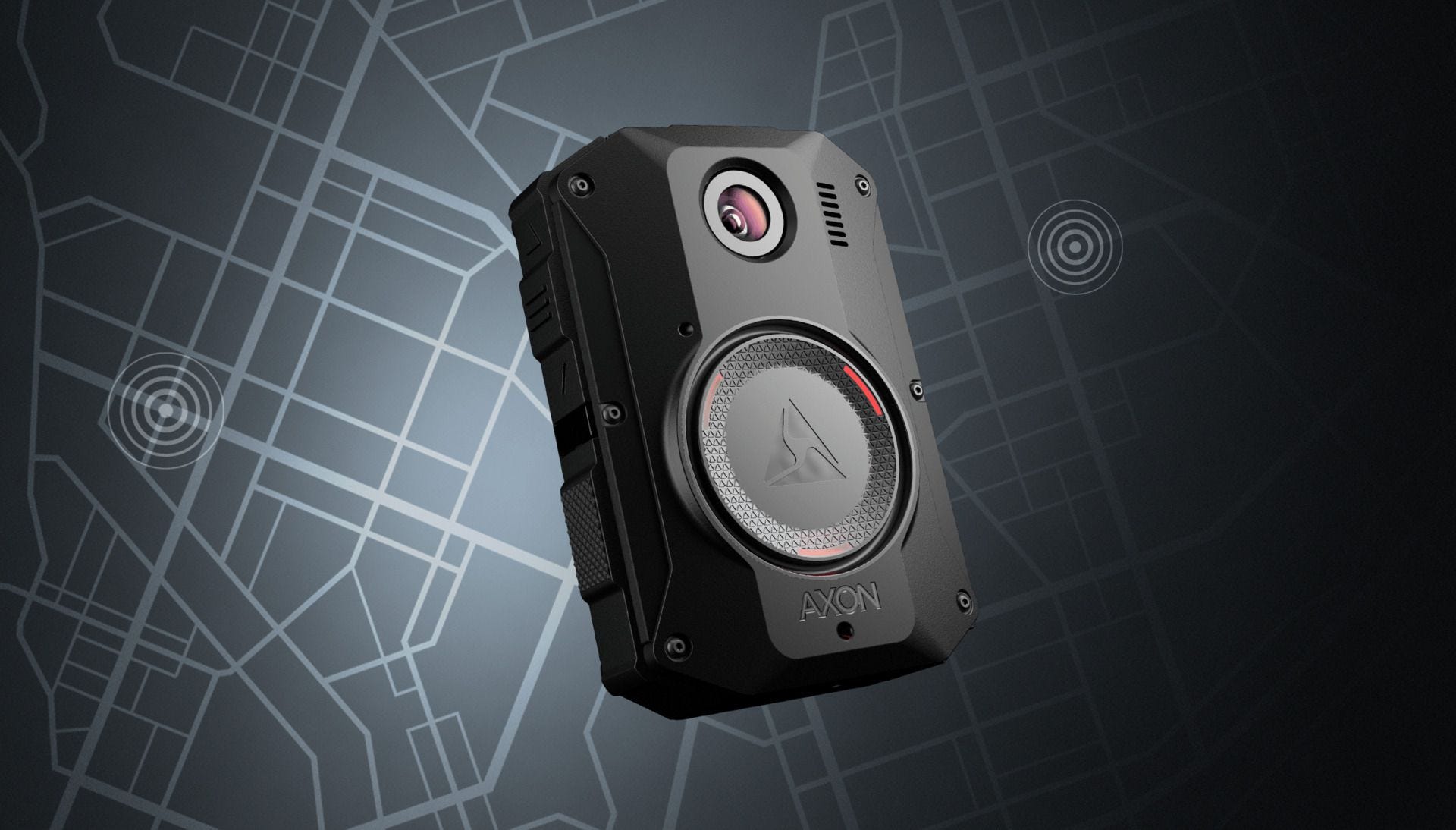
Image source: axon.com
Strengths: Building an Unmatched Public Safety Ecosystem
Dominant Market Position and Recurring Revenue Model
Axon’s stranglehold on the body camera sector represents more than just hardware sales. The company has built what analysts describe as a network effect where each product reinforces the value of others.
The numbers tell a compelling story. As of Q3 2025, annual recurring revenue (ARR) reached $1.3 billion, growing 41% year-over-year. Net revenue retention stands at 124%, meaning existing customers are spending significantly more over time.
Key Performance Metrics
Q3 2025
YoY Growth
Annual Recurring Revenue
$1.3 billion
+41%
Net Revenue Retention
124%
Stable
Future Contracted Bookings
$11.4 billion
+39%
Software & Services Revenue
$305 million
+41%
This recurring revenue foundation provides predictable cash flows that public companies rarely achieve. Software & Services revenue now exceeds $305 million quarterly, with adjusted gross margins above 76%.
Integrated Technology Platform Creates Customer Lock-In
The Axon ecosystem extends far beyond individual products. When a department adopts Axon Body 4 cameras, they typically add Axon Evidence for cloud storage, Draft One for AI-assisted report writing, and Axon Signal for real-time operations.
Customer Journey:
Initial Purchase → Body Cameras + TASER Devices
Year 1-2 → Add Cloud Evidence Management
Year 2-3 → Upgrade to Premium Software Features
Year 3+ → Integrate Fleet Cameras, Drones, VR Training
This layering strategy explains the company’s exceptional net revenue retention. Once agencies commit to the platform, switching costs become prohibitive. Training records, historical evidence, and operational workflows all live within Axon’s infrastructure.
The recent acquisitions of Prepared and Carbyne for 911 call-handling add another layer to this ecosystem. These deals create an end-to-end solution where emergency calls automatically trigger body cameras, dispatch officers, and deploy drones while recording everything in a unified evidence management system.
Financial Performance and Margin Expansion Trajectory
Axon’s full-year 2025 revenue guidance stands at approximately $2.74 billion, representing 31% annual growth. This marks the third consecutive year of 30%+ growth, a remarkable achievement for a company approaching $3 billion in revenue.
The margin story proves equally impressive. Software & Services adjusted gross margin exceeds 76%, with software-only margins surpassing 80%. As this higher-margin segment grows faster than hardware, overall company profitability improves.

Image source: axon.com
Quarterly Revenue Breakdown (Q3 2025):
Total Revenue: $711 million
├── Connected Devices: $405 million (57%)
│   ├── TASER: $238 million
│   ├── Personal Sensors: $107 million
│   └── Platform Solutions: $61 million
└── Software & Services: $305 million (43%)
Innovation Pipeline and R&D Investment
The company’s product roadmap demonstrates sustained innovation across multiple categories. Recent launches include:
TASER 10 devices with enhanced range and capacity
Axon Body Workforce Mini for enterprise customers
Vehicle Intelligence platform with Lightpost and Outpost
Virtual reality training systems scaling nationwide
Draft One AI-powered report writing
Axon’s R&D spending reached $177 million in Q3 2025, representing nearly 25% of revenue. This investment intensity matches software companies rather than traditional hardware manufacturers.
The partnership with Microsoft Azure for Axon Evidence cloud infrastructure provides enterprise-grade security and scalability without requiring Axon to build its own data centers. This capital-efficient approach allows faster innovation cycles.
Opportunities: Expanding the Addressable Market
Total Addressable Market Explosion
Axon’s total addressable market expanded to $159 billion in 2025, more than tripling from approximately $50 billion in 2023. This expansion reflects new categories rather than market share gains in existing products.
The 911 infrastructure upgrade alone represents a $5 billion opportunity added through the Carbyne and Prepared acquisitions. Legacy systems across 6,000+ emergency call centers require modernization, creating a decade-long replacement cycle.
Market Segment
Opportunity Size
Current Position
Body Cameras & Sensors
$12 billion
Market leader (85% share)
TASER Devices
$8 billion
Dominant player
Cloud Software & AI
$35 billion
Fast-growing presence
911 Infrastructure
$5 billion
New entrant via acquisitions
Drones & Robotics
$18 billion
Expanding through Dedrone
Enterprise Security
$25 billion
Early stage with ABW Mini
International Markets
$56 billion
Under-penetrated
Enterprise Market Entry Strategy
The Axon Body Workforce (ABW) Mini launch represents Axon’s first purpose-built product for commercial customers outside law enforcement. Retail, healthcare, and logistics companies face similar accountability and safety challenges.
Early trials with retail customers demonstrate strong demand. These sectors offer faster procurement cycles than government agencies and less pricing sensitivity. If Axon captures just 10% of the enterprise body camera market, it adds billions in revenue potential.
The enterprise opportunity extends beyond cameras:
Enterprise Use Cases:
Retail → Loss prevention, customer disputes, employee safety
Healthcare → Patient care documentation, security incidents
Logistics → Loading dock operations, driver safety, delivery verification
Education → Campus security, incident documentation
Hospitality → Guest disputes, liability protection
International Expansion Runway
Axon generates approximately 80% of revenue from the United States despite public safety being a global need. International revenue grew substantially throughout Europe in 2025, with major contracts signed across multiple countries.
The UK alone has over 150,000 police officers, while European Union countries collectively employ millions of law enforcement and security personnel. Body camera adoption rates outside North America remain below 30% in most developed markets.
Regulatory tailwinds support international growth. Many countries now mandate body camera usage for accountability and transparency. The UK government announced major investments in police technology in 2025, creating procurement opportunities for vendors with proven solutions.
Artificial Intelligence Integration Across Product Line
AI represents both a product enhancement and a new revenue stream. Draft One, which uses Azure OpenAI Service to automatically draft police reports from body camera audio, demonstrates the potential.
Early customers report that Draft One reduces report writing time by 50% or more. Officers spend 30-40% of their shifts on paperwork, so this efficiency gain translates directly to more officers on patrol or significant cost savings.
The AI roadmap extends across the ecosystem:
Axon Assistant for intelligent evidence search
Automated video redaction for privacy compliance
Predictive maintenance for devices
Real-time language translation in body cameras
Computer vision for automatic incident detection
Smart categorization and tagging of evidence
Each AI feature creates opportunities for premium pricing tiers. As agencies see productivity gains, they upgrade to access more capabilities.
Strategic Acquisitions Building Market Position
Axon’s acquisition strategy targets companies that extend the ecosystem into adjacent categories. Recent deals include:
Acquisition
Year
Strategic Rationale
Dedrone
2024
Counter-drone airspace security
Fusus
2024
Real-time crime center operations
Prepared
2025
AI-enhanced 911 call handling
Carbyne
2025
Cloud-native 911 infrastructure
The Carbyne acquisition particularly transforms Axon’s competitive position. For $625 million, Axon gains a full-stack, cloud-native call-taking platform. This moves the company upstream in the public safety workflow, capturing emergencies at the moment citizens call for help.
Integration potential creates value beyond standalone businesses. When a 911 call comes through Carbyne, the system can automatically:
Alert nearby officers with location data
Activate body cameras before officers arrive
Deploy drones to provide aerial reconnaissance
Stream real-time video to command centers
Document everything in Axon Evidence
Weaknesses: Margin Pressures and Operational Challenges
Hardware Margin Compression from Tariffs
Connected Devices adjusted gross margin fell to 52.1% in Q3 2025, down 240 basis points year-over-year. Management attributed this primarily to global tariffs and product mix shifts.
The tariff impact hits particularly hard because many components come from international suppliers. TASER cartridges, camera sensors, and electronic components face additional costs that cannot immediately pass through to customers with existing contracts.
Margin Pressure Sources:
Global Tariffs → +3-5% component costs
Product Mix → More Platform Solutions (lower margin)
Supply Chain → Premium freight and expediting
Labor Costs → Wage inflation in manufacturing
Unlike pure software companies that scale with minimal incremental cost, Axon’s hardware products require manufacturing, logistics, and inventory management. These physical constraints limit margin expansion potential.
High Stock-Based Compensation Impacting Profitability
Full-year stock-based compensation is projected at $580-630 million for 2025, representing over 20% of revenue. While this is a non-cash expense, it represents real dilution to shareholders and suppresses GAAP profitability.
The company’s eXponential Stock Plan and CEO Performance Award create significant accounting charges. Q3 2025 saw GAAP net loss of $2 million despite strong operational performance.
Q3 2025 Profitability Metrics
GAAP
Non-GAAP
Net Income (Loss)
($2) million
$98 million
Net Margin
(0.3%)
13.7%
Diluted EPS
($0.03)
$1.17
While non-GAAP metrics show healthy profitability, GAAP losses create challenges for value-oriented investors and complicate comparisons with competitors using different compensation structures.
Customer Concentration in Government Sector
Approximately 80% of Axon’s revenue comes from government agencies, primarily law enforcement. This concentration creates multiple vulnerabilities.
Government Customer Risks:
Budget Cycles → Revenue timing unpredictability
Political Changes → Shifting priorities and funding
Appropriation Clauses → Contract cancellation rights
Procurement Delays → Extended sales cycles
Economic Downturns → Tax revenue declines
During recessions, state and local tax revenues decline, leading to budget cuts. Public safety typically receives protection, but capital expenditure budgets often face scrutiny. Multi-year contracts provide some insulation, but new deal velocity can slow significantly.
The enterprise expansion addresses this weakness, but commercial customers currently contribute only a small percentage of revenue. Meaningful diversification requires years of successful execution.
Integration Complexity from Multiple Acquisitions
Axon completed or announced four significant acquisitions between 2024 and 2025: Dedrone, Fusus, Prepared, and Carbyne. Each acquisition brings different technology stacks, customer bases, and corporate cultures.
Integration challenges include:
Technology platform unification
Sales force coordination and compensation
Product roadmap prioritization
Customer success team alignment
Back-office system consolidation
Failed integrations destroy value. If acquired companies lose key employees, experience customer churn, or suffer product development delays, the strategic rationale evaporates.
Management’s attention spans finite resources. Time spent managing acquisitions reduces focus on core business execution. Axon must simultaneously integrate four companies while maintaining growth in existing product lines.
Threats: Competition and Regulatory Headwinds
Motorola Solutions Competition Intensifying
Motorola Solutions, a much larger company with $10+ billion in revenue, competes directly in body cameras, evidence management, and now 911 infrastructure. Motorola’s $4.4 billion acquisition of Silvus Technologies strengthens its position in mission-critical wireless communications.
Motorola possesses advantages Axon cannot easily replicate:
Competitive Factor
Motorola Solutions
Axon Enterprise
Annual Revenue
$10+ billion
$2.7 billion
Product Breadth
Radio, video, software, services
Focused on sensors & software
Customer Relationships
Decades-long partnerships
Newer relationships
International Presence
Strong global footprint
Predominantly US-focused
Financial Resources
Larger balance sheet
Smaller but growing
Motorola’s product portfolio includes radio systems that public safety agencies view as mission-critical. These relationships provide cross-selling opportunities for cameras, software, and services. Agencies often prefer single-vendor solutions to simplify procurement and support.
The Carbyne acquisition by Axon prompted Motorola to accelerate its own 911 infrastructure strategy. This competitive response demonstrates that Motorola views Axon as a serious threat, which typically leads to aggressive counter-moves including pricing pressure and bundled offerings.
Regulatory and Civil Rights Scrutiny
Body cameras and TASER devices face ongoing regulatory challenges from multiple directions. Civil rights organizations question conducted electrical weapons, while privacy advocates raise concerns about facial recognition and data retention.
Regulatory Risk Areas:
TASER Classification → ATF regulatory uncertainty
Facial Recognition → Municipal and state bans
Data Privacy → GDPR and similar regulations
Use of Force → Changing standards and training
AI Ethics → Algorithmic bias concerns
Several cities have banned facial recognition technology, limiting Axon’s ability to deploy certain AI features. While Axon publicly committed to not offering facial recognition in body cameras without further study, this self-restriction could become a competitive disadvantage if regulations change.
TASER devices face periodic legal challenges. Product liability lawsuits, while typically unsuccessful, create legal expenses and negative publicity. Any significant judgment or regulatory restriction on TASER sales would materially impact revenue.
Valuation Concerns and Market Expectations
Multiple analysts note that Axon trades at premium valuations relative to both technology and industrial companies. The market prices in continued high growth, leaving limited room for execution missteps.
Some analysts suggest the company is overvalued by 40%+ based on discounted cash flow analysis. If growth slows or margins compress more than expected, the stock could face significant multiple contraction.
High valuations create strategic constraints. Management may feel pressure to maintain growth rates through aggressive acquisitions or pricing decisions that sacrifice long-term positioning for short-term results.
Cybersecurity and Data Breach Risks
Axon stores sensitive law enforcement data including body camera footage, incident reports, and personal information about citizens. A significant data breach or extended outage would damage customer trust and potentially trigger legal liability.
The migration to cloud infrastructure creates both opportunities and vulnerabilities. While Microsoft Azure provides enterprise-grade security, the centralization of data increases the attractiveness of Axon as a target for hostile actors.
Cybersecurity Threat Vectors:
Ransomware → Encrypted data systems
State Actors → Espionage and sabotage
Insider Threats → Employee access misuse
Third-Party Vendors → Supply chain compromises
Physical Breaches → Data center security
Law enforcement agencies have strict data security requirements. Any breach that compromises evidence integrity could disqualify Axon from future contracts. The reputational damage from such an incident could take years to repair.
Economic Sensitivity and Budget Constraints
While public safety enjoys relative budget priority, it remains vulnerable to severe economic downturns. The 2008-2009 recession led to police layoffs and equipment purchases deferrals across many cities.
Current economic indicators show mixed signals:
Interest rates remain elevated, increasing government borrowing costs
Inflation has moderated but remains above historical averages
Tax revenues show strength but could reverse quickly
Federal grants for public safety equipment face political uncertainty
A recession in 2026-2027 would likely slow new customer acquisition and potentially reduce expansion sales to existing customers. While recurring revenue provides stability, even SaaS companies experience churn increases during severe downturns.
Strategic Positioning for 2026 and Beyond
The Ecosystem Play Materializes
Axon’s strategic vision centers on becoming the operating system for public safety. The company wants agencies to adopt Axon for everything from emergency calls through court testimony.
This ecosystem approach creates powerful network effects. Each additional product makes the platform more valuable:
Body cameras generate evidence for storage
Evidence management requires a sophisticated search
Search benefits from AI-powered capabilities
AI improves with more data from cameras
Drones provide aerial footage for evidence
911 integration connects calls to responses
VR training uses real footage for scenarios
The more components an agency adopts, the more difficult switching becomes. Not just because of contractual obligations, but because operational workflows depend on the integrated system.
Software Revenue Mix Transformation
The most important trend for investors involves the Software & Services revenue mix. This segment now represents 43% of total revenue, growing 41% year-over-year compared to 24% for Connected Devices.
Software carries 76%+ gross margins versus 52% for hardware. As software becomes a larger percentage of revenue, overall company margins expand even without hardware margin improvement.
Financial Impact of Mix Shift:
Current Mix: 57% Hardware / 43% Software
Target Mix (2027): 45% Hardware / 55% Software
Margin Impact: +300-500 basis points overall gross margin
This transformation resembles Apple’s services expansion. While hardware drives initial adoption, recurring software revenue provides long-term profitability and valuation expansion.
International Expansion as Growth Driver
US law enforcement represents a mature but stable market. International expansion offers higher growth rates, though with different competitive dynamics and longer sales cycles.
Europe shows strong momentum with multiple countries mandating body cameras. The UK, Germany, France, and Netherlands all announced major procurements in 2024-2025. Australia and Canada similarly show strong adoption.
Emerging markets present longer-term opportunities. As developing countries modernize police forces, they increasingly adopt body cameras for accountability and evidence collection. These markets lack legacy systems, potentially allowing faster deployment of cloud-native solutions.
Balancing Growth Investment and Profitability
Axon faces a classic strategic choice: maximize short-term profitability or invest aggressively for long-term market leadership. Management clearly prioritizes the latter.
R&D spending at 25% of revenue exceeds most industrial companies and many software peers. CapEx guidance of $170-180 million for 2025 funds facility expansion, product development, and capacity increases.
These investments suppress current profitability but position Axon to capture a larger market. The company could easily improve near-term margins by reducing R&D or slowing international expansion. Instead, management invests through the current margin pressure period.
For investors, this strategy makes sense only if it creates durable competitive advantages. The ecosystem approach and customer switching costs suggest these investments will pay long-term dividends.
My Final Thoughts
Axon Enterprise occupies a rare position: market dominance in existing categories combined with substantial whitespace for expansion. The 85% market share in body cameras provides a foundation, while acquisitions and new products address adjacent markets worth tens of billions.
The investment case rests on three pillars.
First, recurring revenue predictability creates financial stability unusual for a hardware company.
Second, the integrated ecosystem generates customer lock-in that competitors struggle to displace.
Third, international and enterprise expansion offers years of growth runway.
Risks warrant serious consideration. Hardware margin pressures from tariffs and competition could persist longer than management projects. The Motorola competitive threat intensifies rather than diminishes. Government customer concentration creates vulnerability to budget cycles. High valuation multiples leave little room for disappointment.
The acquisitions of Prepared and Carbyne represent either strategic genius or dangerous diversification. If successfully integrated, these companies transform Axon from a device vendor into an infrastructure provider. Failed integration wastes capital and management attention at a critical growth phase.
For investors, Axon resembles a classic Rule of 40 SaaS business trapped in a hardware company’s body. The 31% revenue growth combined with 25% EBITDA margins exceeds 55, demonstrating the hybrid model’s power. As software mix increases, this metric should improve further.
The 2026-2027 period will prove decisive.
Can management maintain 25%+ growth while expanding margins?
Will international markets scale significantly?
Do enterprise customers adopt ABW Mini at volumes that matter?
Does the 911 infrastructure play generate meaningful revenue?
Answers to these questions determine whether Axon becomes a $100 billion market cap company or faces a painful valuation reset. The technology, market position, and management team suggest the former outcome. Execution will tell the definitive story.
Disclaimer: This analysis is for informational purposes only and should not be construed as investment advice. Investors should conduct their own due diligence and consult with financial advisors before making investment decisions.