

Dear Investor, Welcome to Deep Research Global.
A quiet but consequential shift is happening at the intersection of AI and materials science.
Cambridge-based CuspAI has just closed a $450 million Series B that pushed its valuation to $2.6 billion, drawing capital from Jeff Bezos, the UK sovereign AI fund, and a coalition of chip industry heavyweights.
The round arrives at a moment when chipmakers are running into the physical limits of the materials they have relied on for decades.
CuspAI’s pitch is that AI can compress materials R&D timelines from years to months.
For investors watching the AI stack widen beyond GPUs and data centers, this deal signals where private capital is redirecting.
Recommended - Read Full Reports

Read All Reports
Disclaimer: This analysis is for informational & educational purposes only and should not be construed as investment advice. Investors should conduct their own due diligence before making investment decisions. Past performance does not guarantee future results.
The Deal Structure and the Investors Behind It
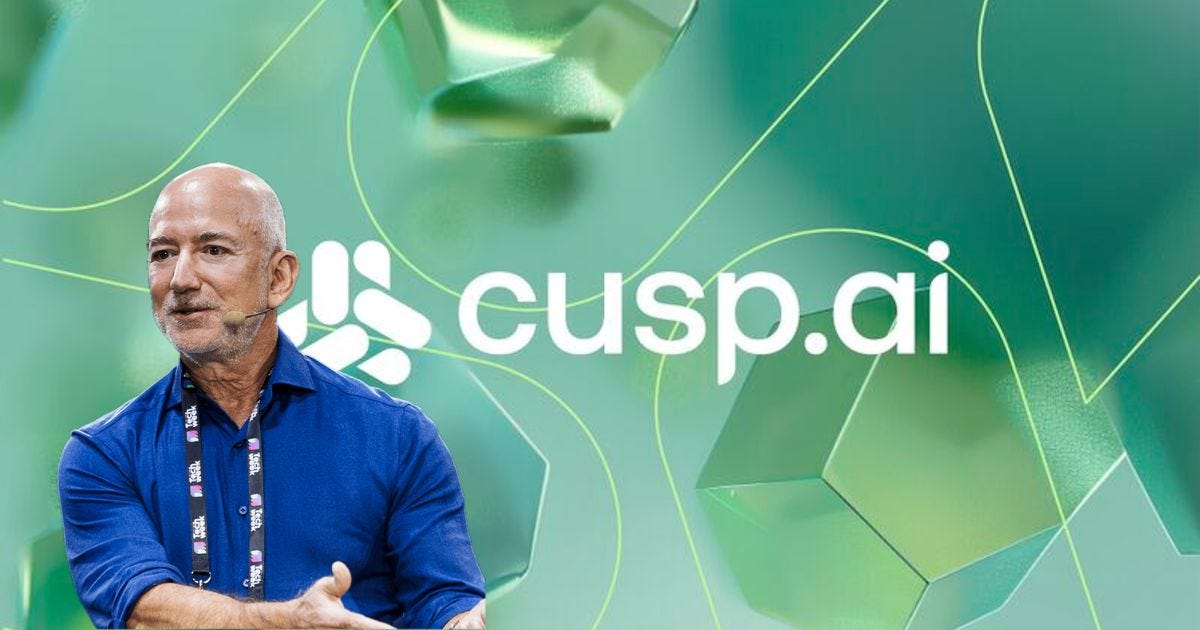
The Series B was co-led by Kleiner Perkins and NEA, two firms with track records in enterprise infrastructure and deep tech. Bezos Expeditions joined alongside Glade Brook Capital Partners, Lux Capital, and AMD Ventures.
Strategic participation from the UK Sovereign AI Venture Fund marks one of the largest state backed AI deals in British history, positioning the UK as an infrastructure partner rather than just a talent pool.
Total funding across CuspAI’s rounds has now surpassed $580 million since its founding in March 2024 by Dr. Chad Edwards and Professor Max Welling, a pioneer of geometric deep learning.
CuspAI Series B snapshot
- Round size: $450 million
- Post money valuation: $2.6 billion
- Lead investors: Kleiner Perkins, NEA
- Strategic partners in round: AMD Ventures, UK Sovereign AI Venture Fund, Bezos Expeditions
- Founded: March 2024, Cambridge, United Kingdom
- Cumulative capital raised: over $580 millionWhy Chipmakers Have a Materials Problem
Modern logic and memory nodes depend on a small basket of exotic elements. Ruthenium, cobalt, tungsten, and various rare earths sit inside interconnects, barriers, and specialized layers where alternatives have been elusive.
The bottleneck is not always what a fab can etch. It’s often what nature has provided.
In an interview, CEO Chad Edwards argued that the entire semiconductor industry is fundamentally a materials science problem waiting for computational leverage.
AI driven demand is already reshaping the critical minerals market, with concentrated supply chains vulnerable to geopolitical shocks. CuspAI is one of the first venture backed answers targeting that risk directly.
Bezos himself framed that the objective is to reduce or eliminate chipmaking’s reliance on rare metals with supply chain risks, including ruthenium.
Inside the AI Materials Foundry
Alongside the raise, CuspAI unveiled the AI Materials Foundry, a global network combining data, wet labs, compute capacity, and scientific expertise.
The Foundry launched with more than 45 founding partners spanning chip design, cloud, industrial manufacturing, and academic research. Confirmed participants include NVIDIA, Meta, and Hyundai Motor Group.

Rather than a pure research lab, CuspAI is building a two sided platform: generative models on one side and physical validation loops on the other, so predicted materials can be synthesized and tested in months rather than years.
AI Materials Foundry structure
- Founding members: 45 plus, including NVIDIA and Meta
- Core focus areas: semiconductors, carbon capture, advanced manufacturing
- Anchor partnership: five year deal with A*STAR in Singapore
- Near term research allocation: roughly 80 percent toward semiconductor materials
The A*STAR Anchor and the Singapore Bridge
The most concrete Foundry project already in motion is a five year partnership between CuspAI and Singapore’s Agency for Science, Technology and Research.
The collaboration pairs CuspAI’s generative models with A*STAR’s autonomous synthesis and characterization facilities. The goal is experimental validation of novel materials across semiconductors, carbon capture, and water purification.
For chip investors, the Singapore link matters because A*STAR sits inside a fabrication ecosystem that includes advanced packaging, compound semiconductors, and materials characterization at scale.
Nvidia, Meta, and the Strategic Logic for Hyperscalers
Nvidia’s involvement extends beyond the compute layer. Its role inside the Foundry is to