

Welcome to Deep Research Global - The institutional-grade investment analysis newsletter, built exclusively for savvy investors.
As a paid member you get access to:
Daily - Deep-dive fundamental analysis reports & investment insights
Weekly - Earnings analysis of key releases
One subscription. Unlock full archive - 100s of stock/company analysis reports (updated regularly)
In case you missed it, here are the latest “fundamental analysis” reports:
List of All Reports - Check It Out
Executive TL;DR
Intuitive Surgical (ISRG) posted $2.89 billion in Q2 2026 revenue, up 19% year over year, with worldwide procedures growing roughly 16% and da Vinci procedures rising approximately 15%.
The da Vinci installed base reached 11,710 systems as of June 30, 2026, with 246 of the 468 quarterly placements being the next-generation da Vinci 5 platform, deepening the recurring-revenue moat.
The stock has been under pressure through 2026, reflecting a slowdown in U.S. procedure growth, GLP-1 drug pressure on bariatrics, and competitive noise from Medtronic, Johnson & Johnson, and CMR Surgical.
Free cash flow generation is accelerating meaningfully, with first-half 2026 free cash flow of $1.8 billion, giving Intuitive optionality to invest through the cycle and continue buybacks.
Here’s what you get in this analysis:
Intuitive Surgical Company Profile: Key Facts Snapshot
Intuitive Surgical Investment Thesis
Intuitive Surgical Business Model Overview
Three Revenue Engines
Placement Structures Are Evolving
Services Compound Alongside the Fleet
Digital Layer Is the New Moat
Attach Economics and the Complexity Premium
Intuitive Surgical Revenue Analysis
Where 2026 Revenue Is Coming From
The Recurring-Revenue Ratchet
Procedure Growth Is the Master Variable
International Momentum Offsets U.S. Deceleration
Q2 FY2026 Earnings Report Analysis
Headline Numbers
The Guidance Reset That Rattled the Tape
Earnings Quality
EPS Trajectory
Cash Flow Mechanics
Balance Sheet Health
Intuitive Surgical Segment-by-Segment Teardown
1. Da Vinci Multiport (Xi, X, Legacy)
2. Da Vinci 5
3. Da Vinci SP (Single-Port)
4. Ion Endoluminal System
5. Digital, Learning, and Services
Major Intuitive Surgical Competitors
ISRG vs. Medtronic (Hugo)
ISRG vs. Johnson & Johnson (Ottava)
ISRG vs. CMR Surgical (Versius / Versius Plus)
ISRG vs. Stryker (Mako) and Zimmer Biomet (Rosa)
ISRG (Ion) vs. Johnson & Johnson (Monarch)
Intuitive Surgical Strategic Context
The Quintuple Aim Framework
Multi-Generational Product Cadence
Manufacturing and Supply Chain Investments
Tariffs and Geopolitical Overhang
Digital Transformation of Surgery
Intuitive Surgical Valuation Framework Analysis
Multiple Compression Is Real
DCF Anchor: What the Cash Flows Suggest
Sum-of-the-Parts Framing
What a Rerating Looks Like
Bull, Base, and Bear Case Scenario Analysis
Bull Case
Base Case
Bear Case
Key Risks for Intuitive Surgical
Catalysts to Watch
Financial Ratio and Metrics Deep Dive
Profitability Metrics
Capital Efficiency
Growth Metrics
Balance Sheet Ratios
Regulatory and Reimbursement Outlook
FDA and Global Regulatory Momentum
Reimbursement Environment
CMS and Payer Policy
Cost Structure and Operating Leverage
Manufacturing Footprint
R&D Reinvestment Discipline
International Growth Analysis
Europe
Japan and Korea
China
Rest of World
Digital Platform and AI Roadmap
My Intuitive Ecosystem
Force Feedback and Real-Time Insights
SimNow and Training Infrastructure
Latest Analyst Price Targets
Long-Term Compounding Framework
My Final Thoughts
Official Sources & Data
Disclaimer: This analysis is for informational & educational purposes only and should not be construed as investment advice. Investors should conduct their own due diligence before making investment decisions. Past performance does not guarantee future results.
Introduction
The story most investors were told about Intuitive Surgical (ISRG) for two decades was simple. Build a better robot, sell more systems, watch procedures compound, and enjoy razor-and-blade economics with almost no serious competition.
That story is now being stress-tested in real time.
Weight-loss drugs are chipping away at bariatric procedure counts.
Medtronic finally has a U.S.-cleared Hugo system in commercial use.
Johnson & Johnson has submitted Ottava to the FDA.
Tariffs and China friction are pinching margins.
U.S. procedure growth is decelerating to the low-teens.
Yet Intuitive still placed 468 da Vinci systems in a single quarter, generated $2.89 billion in revenue, and produced $1.8 billion in first-half free cash flow.
The tension between narrative decay and financial strength is exactly why this stock is one of the more interesting large-cap medtech setups heading into the balance of 2026.
Let’s analyze it all.

Intuitive Surgical Company Profile: Key Facts Snapshot
Intuitive Surgical, Inc. is the pioneer and global leader in robotic-assisted, minimally invasive surgery.
The company designs, manufactures, and markets the da Vinci multiport surgical system, the da Vinci SP single-port system, the Ion endoluminal system for lung biopsy, and a growing portfolio of digital, learning, and services offerings that surround its capital platforms.
The company was founded in 1995, went public in 2000, and remains headquartered in Sunnyvale, California.
Its business model is anchored by a large installed base of capital equipment, with the majority of revenue recurring through instruments, accessories, and services tied to each procedure performed on that base.
Ticker:                    ISRG (Nasdaq)
Sector / Industry:         Healthcare / Medical Devices
Headquarters:              Sunnyvale, California
Founded:                   1995
CEO:                       Gary S. Guthart, Ph.D.
Global installed base:     11,710 da Vinci systems; 1,096 Ion systems
FY2025 Revenue:            ~$10.1 billion
Q2 2026 Revenue:           $2.89 billion (+19% YoY)
Cash & Investments:        $8.63 billion
Debt:                      Effectively debt-free
Primary Platforms:         da Vinci multiport, da Vinci 5, da Vinci SP, Ion
Ownership, Governance, and Capital Structure
Intuitive operates with an unusually clean capital structure. It carries effectively no long-term debt, and its balance sheet is dominated by cash, short-term investments, and product inventory built for a global installed base.
The company has a common stock repurchase program that the board expanded in April 2026, reflecting management’s confidence in long-term cash generation. Intuitive does not pay a cash dividend, and there is no indication that one is being contemplated in the near term.
CAPITAL STRUCTURE SNAPSHOT
-------------------------
Long-term debt:            ~$0 (effectively debt-free)
Cash & investments:        $8.63B (Q2 2026)
Dividend:                  None
Repurchase program:        Expanded April 30, 2026
FY2026 gross margin gd:    68.0% - 69.0% (non-GAAP)
FY2026 opex growth gd:     +11% to +13% (non-GAAP)
The company reaches customers globally with direct operations across North America, Europe, and much of Asia, with a joint-venture structure in China through Intuitive Fosun.
Intuitive Surgical Investment Thesis
The investment thesis is built on four load-bearing pillars, each of which is being tested but still standing after Q2 2026 results.
Pillar 1: The Installed-Base Compounding Engine
Every da Vinci system Intuitive places is a multi-year annuity. Once installed, that system generates roughly $1,800 to $3,700 of instrument and accessory revenue per procedure, plus recurring service revenue, plus increasingly high-value software subscriptions.
The company placed 468 da Vinci systems in Q2 2026 alone. That’s on top of a base that has grown to 11,710 systems worldwide, an increase of 12% year over year.
INSTALLED-BASE COMPOUNDING (Q2 2026)
-----------------------------------
da Vinci installed base:      11,710 systems (+12% YoY)
Ion installed base:           1,096 systems (+21% YoY)
Q2 2026 da Vinci placements:  468 systems
Q2 2026 da Vinci 5 mix:       246 systems (53% of placements)
Q2 2026 SP placements:        38 systems (vs. 23 in Q2 2025)
Q2 2026 Ion placements:       55 systems
Pillar 2: Recurring Revenue Mix
Second-quarter 2026 recurring revenue reached $2.47 billion, or roughly 85% of total revenue.
This is what makes Intuitive economically defensible even when capital budgets tighten. Hospitals cannot simply “un-buy” a robot mid-cycle, and each surgeon trained on da Vinci creates switching-cost inertia that competitors have to overcome one clinician at a time.
Recurring revenue is also the reason the business does not behave like a traditional cyclical capital-equipment name. Even in quarters where system placements slow, the annuity keeps compounding as long as procedures grow.
Pillar 3: The Da Vinci 5 Upgrade Cycle
The da Vinci 5 platform is arguably the most important product launch in the company’s history since the original da Vinci Xi.
It brings force feedback, 10,000 times the computing power of Xi, an integrated real-time surgical insights layer, and more than 150 individual enhancements.
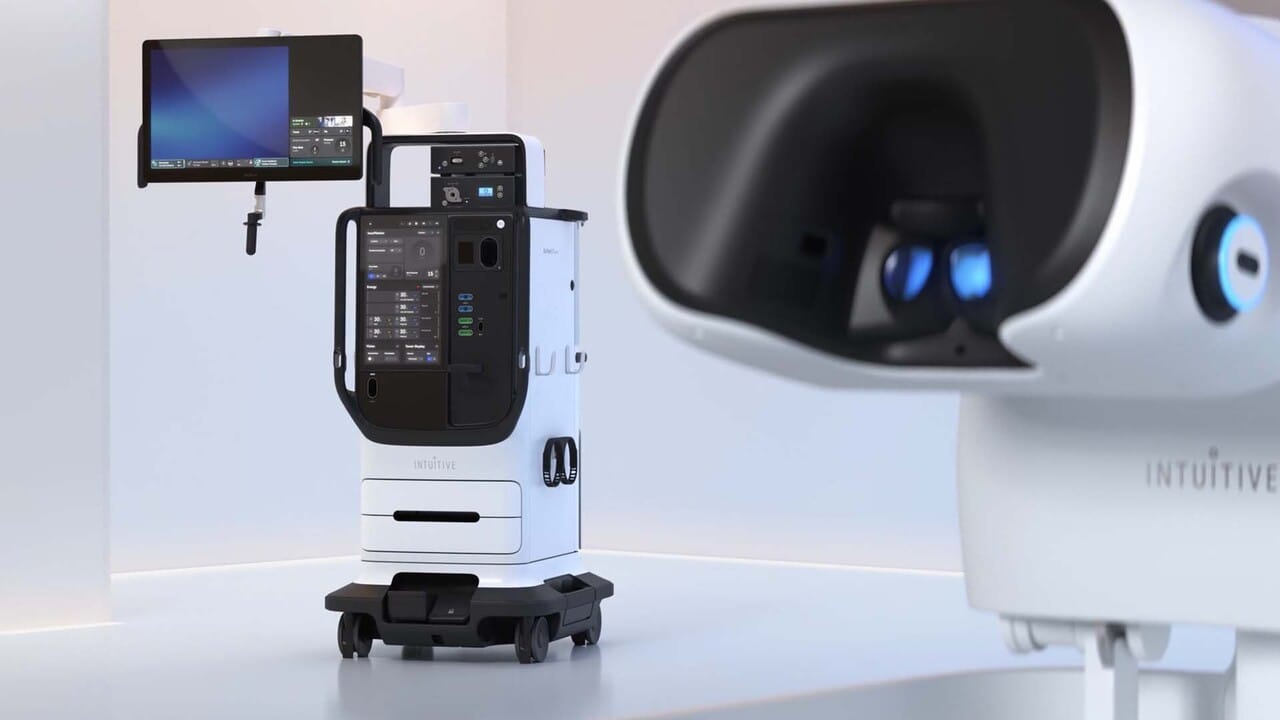
The economics of da Vinci 5 matter as much as the clinical improvements.
Higher list prices, richer instrument attach, and integrated software subscriptions like My Intuitive+ all lift lifetime revenue per system. Peer-reviewed force-feedback studies show up to a 43% reduction in tissue force, a clinical differentiator that is not trivial to replicate.
Pillar 4: Ion and the Expansion Beyond Multiport
Ion is the other product doing the heavy lifting. Ion procedures grew approximately 36% in Q2 2026, with cumulative lifetime procedures crossing 400,000, and the installed base reaching 1,096 systems.
Ion opens up a completely separate procedure category, robotic bronchoscopy for peripheral lung biopsy, that is not vulnerable to the same competitive pressures as multiport soft-tissue surgery. It expands Intuitive’s addressable market beyond the operating room and into diagnostic pulmonology.
The clinical data behind Ion is arguably its most durable competitive asset. Recent Ion-focused research reports 91.5% sensitivity for malignancy and diagnostic yields north of 90% in real-world use. Earlier PRECIsE study preliminary results showed an 83% diagnostic yield in a rigorously designed prospective setting.
Diagnostic yield is the metric that matters most to pulmonologists and thoracic surgeons choosing between platforms.
If Ion continues to consistently deliver north of 80% diagnostic yield across community and academic sites, the competitive contest with alternative bronchoscopy platforms becomes very difficult to lose.
Pillar 5: The Ecosystem and Training Moat
A fifth pillar deserves attention even though it does not appear on any income-statement line.
Intuitive has spent two decades building the largest surgeon-training ecosystem in robotic surgery. That ecosystem includes SimNow simulation, on-site proctoring, fellowship programs, and formal academic partnerships through the company’s professional education programs.
On the executive side, Intuitive 360 is an annual conference for executive, clinical, and operational leadership focusing on robotic service line development. Those are relationships you cannot build overnight.
Every new surgeon trained on da Vinci is a small but permanent switching cost against every competitor. Multiply that across the tens of thousands of trained surgeons worldwide, and the ecosystem becomes an economic moat that is arguably wider than the product moat itself.
Where the Thesis Is Being Tested
The thesis is not without cracks.
U.S. procedure growth decelerated in Q2 2026, bariatric volumes softened, and international placements are being throttled by capital-budget scrutiny in Europe and China. Competitors are no longer just in test phase either. Medtronic is doing real cases in real U.S. hospitals with Hugo. J&J’s Ottava has now completed a pivotal study.
None of that breaks the thesis. But, all of it changes the pace at which it plays out, and that’s the setup investors need to understand for the balance of 2026 and beyond.
Intuitive Surgical Business Model Overview
At its core, Intuitive is a razor-and-blade business dressed in the language of surgical robotics.
But the razor is a $2 million capital asset, the blades cost thousands of dollars per procedure, and the whole system is wrapped in software, services, and clinician training that create some of the highest switching costs in medical devices.
Three Revenue Engines
The company reports revenue in three primary lines. In Q2 2026 those broke out to instruments and accessories of $1,734.9 million, systems of $685.0 million, and services of $472.4 million.
Q2 2026 REVENUE BY LINE
-----------------------
Instruments & Accessories:  $1,734.9M  (60% of revenue)
Systems:                    $685.0M    (24% of revenue)
Services:                   $472.4M    (16% of revenue)
Total:                      $2,892M    (+19% YoY)
Recurring (I&A + Services): ~$2,207M   (~76% of revenue)
Instruments and accessories are the true annuity.
Each procedure consumes a set of single-use or limited-use tools, and the mix of those tools varies with procedure complexity. The company generally earns between $900 and $3,700 of instruments and accessories revenue per procedure, depending on the type and complexity of surgery.
Placement Structures Are Evolving
Systems revenue is more nuanced than a simple hardware sale.
Intuitive offers several ways for a hospital to acquire a robot. Some are outright purchases. Some are leases. Some are operating leases with usage-based upgrades.
And, importantly, some are placed under all-inclusive subscription-style agreements that bundle software like My Intuitive+ into the deal.
The first wave of My Intuitive+ renewals executed in Q2 2026, with management citing zero customer opt-outs to date.
That’s an early but meaningful data point about stickiness.
Services Compound Alongside the Fleet
Services revenue, at $472 million in Q2 2026 and up roughly 21% year over year, tracks the growth of the installed base and the mix shift toward da Vinci 5.
Da Vinci 5’s higher service pricing, combined with a larger and younger fleet, drives services growth that is structurally faster than procedure growth.
Digital Layer Is the New Moat
Software is where the business model quietly evolves.
The My Intuitive digital ecosystem now surrounds the console with case tracking, learning modules, inventory management, and AI-driven video analysis. This layer is not a rounding error. It is a moat under construction.
Every additional workflow that runs through My Intuitive raises the cost of a competitor’s future switch.
When a hospital’s surgical planning, training, quality dashboards, and case analytics all live inside Intuitive’s software, ripping out the robot means ripping out the operating model.
Attach Economics and the Complexity Premium
One underappreciated aspect of the business model is the way instrument and accessory revenue scales with procedure complexity. A basic cholecystectomy consumes a very different tool set than a complex prostatectomy or a colorectal resection.
The wide $900 to $3,700 revenue-per-procedure range reflects that mix. As Intuitive’s platforms expand into more complex procedure categories, blended revenue per procedure quietly drifts upward.
ATTACH ECONOMICS EXAMPLE
------------------------
Simple procedure (cholecystectomy):     ~$900-$1,500 I&A revenue
Mid-complexity (hysterectomy):          ~$1,500-$2,500 I&A revenue
High-complexity (colorectal, prostate): ~$2,500-$3,700 I&A revenue
Da Vinci 5 uplift:                      Additional software attach
This is how a mature installed base can continue to grow revenue per system even without adding new placements. Mix improvement is a hidden growth lever that quietly compounds.