- Deep Research Global
- Posts
- T-Mobile - SWOT Analysis Report (2026)
T-Mobile - SWOT Analysis Report (2026)
Since completing its merger with Sprint in April 2020, T-Mobile US, Inc. $TMUS ( ▲ 1.08% ) has fundamentally reshaped the U.S. wireless marketplace. With the third quarter of 2025 delivering record-breaking customer growth and industry-leading financial performance, investors are closely monitoring how this telecommunications giant will navigate the opportunities and challenges that lie ahead.
The wireless telecommunications sector remains a cornerstone of modern infrastructure, with T-Mobile positioning itself as America’s “supercharged Un-carrier.”
This analysis examines the strategic strengths, operational weaknesses, market opportunities, and external threats facing T-Mobile as it charts its course through 2026 and beyond.
Table of Contents
Understanding T-Mobile’s Current Market Position
T-Mobile’s transformation from an industry underdog to a market leader represents one of the most significant turnarounds in American telecommunications history. As of Q3 2025, the company serves 139.9 million total customer connections, placing it neck-and-neck with longtime industry leaders AT&T and Verizon.
The competitive dynamics in the U.S. wireless market have shifted dramatically. According to TeleGeography, T-Mobile commanded approximately 35% market share as of early 2025, with Verizon at 34% and AT&T at 31%. This near-parity among the “Big Three” carriers represents a fundamental change from the pre-merger era when T-Mobile trailed significantly behind its larger rivals.
Recent Financial Performance Snapshot
T-Mobile’s Q3 2025 results showcased the company’s momentum:
Financial Metric | Q3 2025 Value | Year-over-Year Growth |
|---|---|---|
Total Service Revenue | $18.2 billion | +9% |
Postpaid Service Revenue | $14.9 billion | +12% |
Net Income | $2.7 billion | +11% |
Core Adjusted EBITDA | $8.7 billion | +6% |
Operating Cash Flow | $7.5 billion | +21% |
Adjusted Free Cash Flow | $4.8 billion | Best in industry |
These figures demonstrate not just growth, but industry-leading growth rates that outpace competitors by multiples in several key categories.
STRENGTHS: The Foundation of Competitive Advantage
Superior 5G Network Infrastructure and Coverage
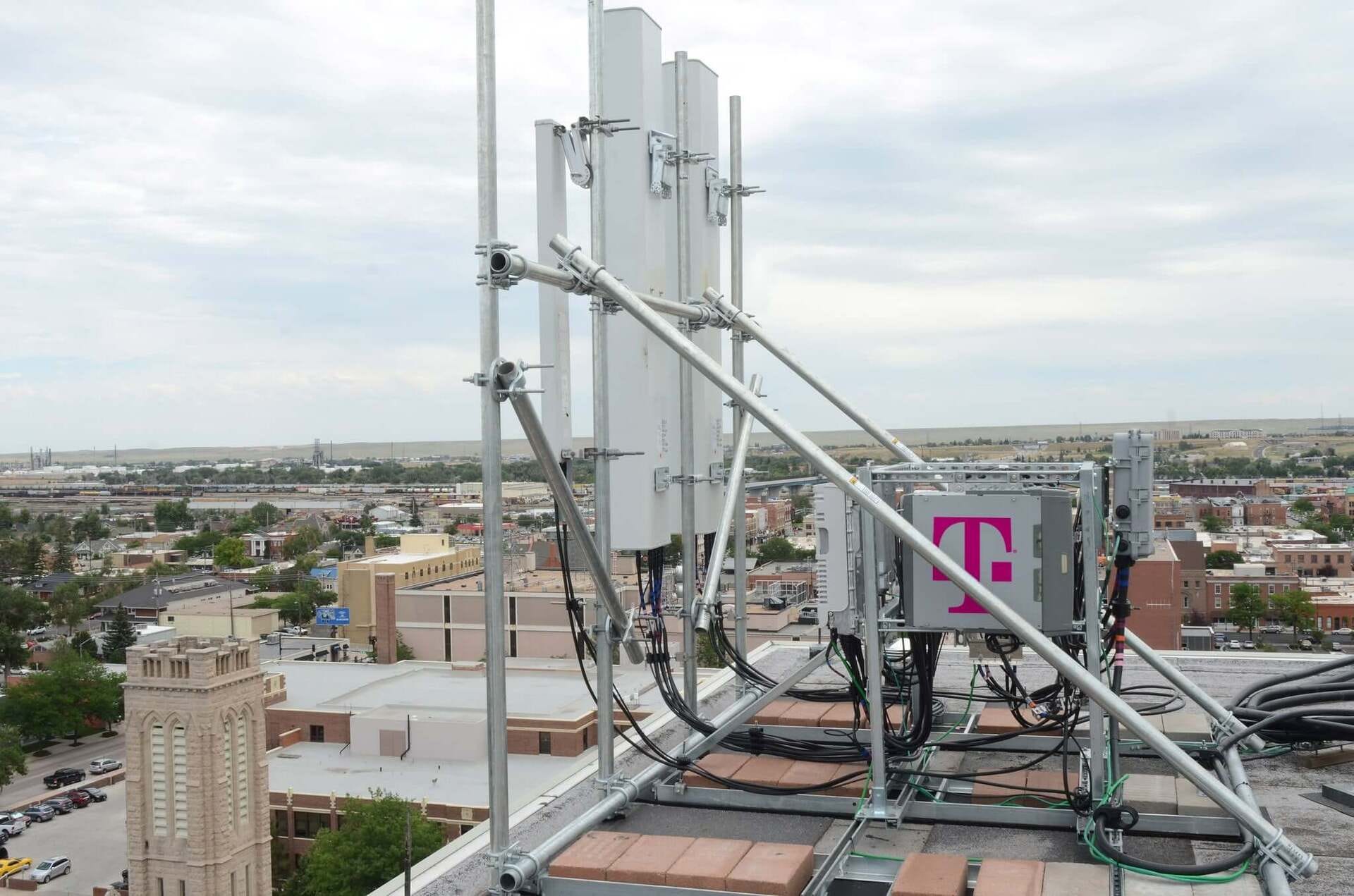
T-Mobile’s most significant competitive advantage stems from its 5G network infrastructure, which industry analysts consistently rate as best-in-class. The company achieved a historic milestone in April 2025 by deploying 5G Advanced nationwide, becoming the first U.S. carrier to reach this technological benchmark.
The Sprint merger proved transformative for network capabilities. By integrating Sprint’s extensive mid-band spectrum holdings (particularly the valuable 2.5 GHz band), T-Mobile created what independent testing firm Opensignal recognized as the 5G Global Winner in 5G Coverage Experience and Global Leader in 5G Reliability.
Key Network Performance Indicators (Q3 2025):
• 5G Coverage: Reaches 99% of U.S. population
• Average 5G Speeds: 90% faster than benchmark competitors on iPhone 17
• Fixed Wireless Speeds: Nearly 50% faster median downloads than nearest peer
• Network Sites: ~70% supporting 5- and 6-carrier aggregation
• Technology Leadership: L4S deployed on all 5G sites
The company’s $2 billion multi-year network expansion in Florida, completed in July 2025, exemplifies its commitment to infrastructure investment. This pattern of strategic deployment across high-value markets reinforces network quality while defending against competitive incursions.
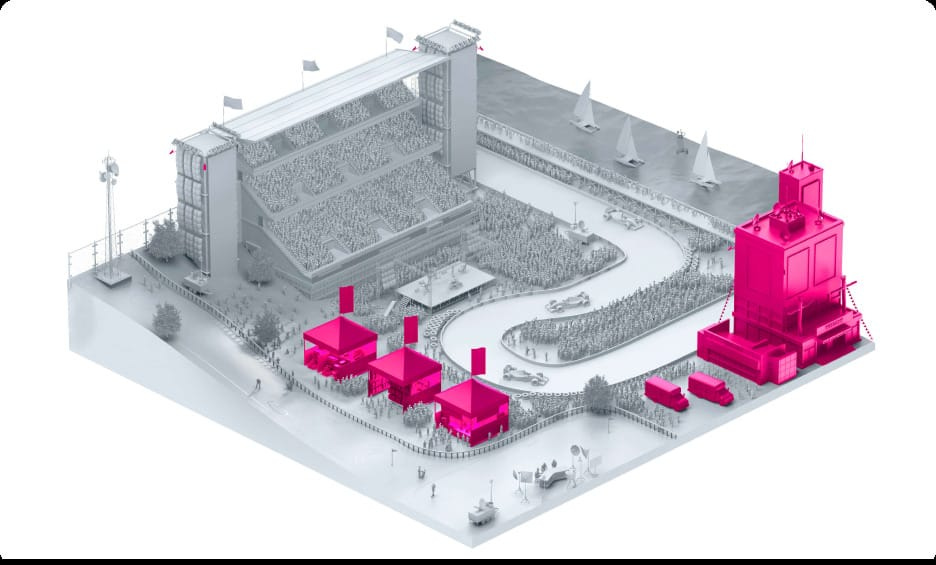
Image source: t-mobile.com
5G Standalone Architecture and Network Slicing Capabilities
T-Mobile’s first-mover advantage in 5G Standalone (SA) architecture provides capabilities that competitors are only now beginning to deploy nationwide. Unlike 5G Non-Standalone (NSA) networks that rely on 4G LTE infrastructure, 5G SA operates independently, enabling advanced features like network slicing.
Network slicing allows T-Mobile to create virtual, customized networks within its physical infrastructure. This technology enables:
Priority access for first responders through the T-Priority program, delivering 2.5X faster all-network speeds and 40% more 5G capacity
Enterprise-grade reliability for business customers requiring guaranteed performance
Optimized event connectivity for venues and large gatherings
SuperMobile business plans with differentiated service tiers
The commercial deployment of network slicing positions T-Mobile ahead of AT&T and Verizon in monetizing 5G capabilities for enterprise customers, a segment that commands premium pricing and exhibits lower churn rates.
Market-Leading Customer Growth and Retention Metrics
T-Mobile’s customer acquisition and retention performance in 2025 significantly outpaced competitors:
Customer Metric | Q3 2025 | Competitive Context |
|---|---|---|
Total Postpaid Net Adds | 2.3 million | Best in industry |
Postpaid Phone Net Adds | 1.0 million | Highest Q3 in over a decade |
Postpaid Account Net Adds | 396,000 | Up 26% YoY, best in industry |
Postpaid Phone Churn | 0.89% | Industry-leading low churn |
Total Broadband Net Adds | 560,000 | Best in industry |
The postpaid phone churn rate of 0.89% represents best-in-class customer retention, particularly impressive given the company’s aggressive pricing strategy. This low churn translates directly into higher lifetime customer value and reduced acquisition costs relative to competitors.
T-Mobile’s customer acquisition momentum stems from its “Un-carrier” value proposition: combining network quality leadership with competitive pricing and superior customer experience. This three-pronged approach creates a differentiation that resonates particularly strongly with price-conscious consumers and families.
Strategic Acquisition Integration and Synergy Realization
The UScellular acquisition, which closed on August 1, 2025, demonstrates T-Mobile’s operational excellence in post-merger integration. The company raised synergy expectations to $1.2 billion in annual run-rate cost savings, representing a 20% increase from initial projections, while accelerating the integration timeline from three-to-four years to just two years.
This acquisition brought:
UScellular Transaction Benefits:
Spectrum Assets:
• Valuable mid-band and low-band spectrum licenses
• Enhanced network capacity in rural and suburban markets
• Strategic frequency holdings complementing existing portfolio
Customer Base:
• 3.3 million postpaid phone customers
• 390,000 postpaid other customers (including 141,000 5G broadband)
• Opportunity to apply proven ARPA expansion playbook
Operational Synergies:
• $950 million in opex run-rate synergies
• $250 million in capex run-rate synergies
• Improved rural coverage footprint
Beyond UScellular, T-Mobile’s fiber strategy through joint ventures with Metronet and Lumos extends its service capabilities into fixed broadband, creating bundle opportunities and reducing customer churn through multi-service relationships.
Strong Financial Position and Cash Generation
T-Mobile’s financial health provides strategic flexibility for both offensive and defensive maneuvers:
Robust Free Cash Flow: Adjusted free cash flow of $4.8 billion in Q3 2025 enables simultaneous investment in network, shareholder returns, and strategic acquisitions
Stockholder Returns Program: Returned $3.5 billion to shareholders in Q3 through $2.5 billion in buybacks and $987 million in dividends
Cumulative Shareholder Returns: $41.8 billion since program inception (Q3 2022 through Q3 2025)
Operating Leverage: Core Adjusted EBITDA margin expansion demonstrates operational efficiency gains
The company’s ability to generate substantial cash flow while maintaining network investment levels positions it favorably for long-term competitive positioning.
WEAKNESSES: Areas Requiring Strategic Attention
Persistent Cybersecurity Vulnerabilities
T-Mobile’s cybersecurity track record represents perhaps its most significant operational weakness. The company experienced multiple data breaches between 2018 and 2023, resulting in compromised customer data affecting tens of millions of accounts.
Recent developments heighten concerns:
Regulatory Penalties: In October 2024, T-Mobile and AT&T received multimillion-dollar fines from the FCC for cybersecurity lapses, with T-Mobile agreeing to pay over $15 million to settle regulatory claims tied to four separate failures
Salt Typhoon Campaign: T-Mobile was targeted in late 2024 by the “Salt Typhoon” cybercriminal organization in coordinated attacks against U.S. wireless carriers
Reputational Impact: Repeated security incidents damage brand trust and create customer acquisition headwinds
To address these vulnerabilities, T-Mobile unveiled new cyber defense and executive briefing centers in October 2025. However, rebuilding trust after multiple breaches requires sustained excellence over years, not months.
For investors, cybersecurity risks translate into potential future costs through regulatory fines, legal settlements, remediation expenses, and elevated customer acquisition costs due to damaged reputation.
Brand Perception Challenges Despite Network Improvements
While T-Mobile has achieved technical network parity or superiority versus competitors, consumer perception lags objective performance metrics. The company acknowledged “ongoing momentum in network perception with lots of room to run” during Q3 2025 earnings, indicating significant gaps remain between actual network quality and customer perceptions.
This perception gap manifests in several ways:
Legacy Brand Positioning: Many consumers still view T-Mobile through the lens of its pre-merger identity as a lower-tier, cheaper alternative
Coverage Skepticism: Despite extensive 5G deployment, doubts persist about coverage reliability in rural areas
Business Market Penetration: Enterprise customers exhibit conservatism in switching from established relationships with Verizon and AT&T
The company’s digital transformation initiatives aim to improve customer experience, but changing entrenched perceptions requires sustained marketing investment and consistent service delivery.
Rising Churn Pressure and Pricing Challenges
Despite industry-leading churn rates, T-Mobile faces emerging pressures that could erode retention performance:
Postpaid Phone Churn Uptick: Q3 2025 churn of 0.89% increased 3 basis points year-over-year, attributed to “increased marketplace activity”
Competitive Promotional Environment: AT&T and Verizon have intensified device promotions and discount offers to defend market share
Price Increase Backlash: Customer complaints about price increases in 2025 generated negative publicity and created retention challenges
ARPA Dilution from Acquisitions: The UScellular and Metronet customer bases came with lower Average Revenue Per Account, diluting consolidated metrics by approximately $1.50 in Q3 2025
The company’s three-year device financing programs represent an attempt to reduce churn through longer financial commitments, but this strategy risks customer dissatisfaction if perceived as reducing flexibility.
Capital Expenditure Intensity and Margin Pressure
T-Mobile’s network leadership requires sustained high capital investment levels. Capital expenditures increased 35% year-over-year to $2.6 billion in Q3 2025, including:
Planned higher capital purchases for greenfield site builds
Incremental capex from UScellular acquisition integration
Ongoing 5G densification and capacity expansion
Fiber infrastructure investment through joint ventures
Full-year 2025 capex guidance of approximately $10.0 billion (up from earlier guidance of $9.5 billion) represents substantial ongoing investment requirements. For investors, this capex intensity limits margin expansion potential and requires careful monitoring to verify returns justify the spending levels.
The telecommunications industry’s capital-intensive nature creates inherent margin constraints compared to asset-light business models, and T-Mobile’s growth strategy amplifies this characteristic.
OPPORTUNITIES: Pathways for Future Growth
Fixed Wireless Access (FWA) and Broadband Market Expansion
T-Mobile’s 5G home internet product represents one of its most promising growth vectors. The company added 560,000 total broadband net customers in Q3 2025 alone, demonstrating strong market traction.
The broadband opportunity encompasses multiple segments:
Residential Fixed Wireless Access
Target market of approximately 50 million homes nationally
Median download speeds nearly 50% faster than nearest peer competitor
Simple installation without truck rolls or complex infrastructure
Competitive pricing versus cable incumbents
Minimal incremental capex given existing tower infrastructure
Business Internet Services
Small business internet plans starting at $50/month with five-year price guarantees
Enterprise business broadband for larger organizations
Government and education sector connectivity solutions
Higher ARPU and lower churn than residential customers
Fiber-to-the-Home Strategy
Partnership approach through Metronet, Lumos, and U.S. Internet acquisitions
Goal to reach 12 to 15 million homes with fiber by 2030
Combined wireless and fiber bundles to reduce churn and increase household ARPU
T-Mobile’s target of 12 million total broadband subscribers by 2028 would represent substantial revenue contribution at attractive margins given the capital-light nature of wireless broadband versus wireline infrastructure.
Enterprise and Business Segment Monetization
The enterprise market represents T-Mobile’s most significant underpenetrated opportunity. Historically strong with consumer and small business customers, T-Mobile has lagged in large enterprise accounts where Verizon and AT&T maintain dominant positions.
Recent initiatives target this gap:
5G Advanced Network Solutions
Edge Control and T-Platform services for large enterprises launched in October 2025
Network slicing for guaranteed performance and security
SuperMobile business plans offering differentiated service tiers
Private network solutions for manufacturing, logistics, and government applications
Vertical-Specific Solutions
First responder services through the T-Priority program
Healthcare connectivity for telemedicine and remote patient monitoring
Retail point-of-sale optimization with guaranteed network performance
Education institution connectivity programs
IoT and Machine-to-Machine Services
Connected vehicle platforms
Industrial IoT applications
Smart city infrastructure
Asset tracking and fleet management
Enterprise customers typically exhibit:
30-50% lower churn rates than consumer segments
2-3X higher ARPU
Multi-year contract commitments
Bundle opportunities across voice, data, and IoT services
Success in enterprise markets could materially improve T-Mobile’s profitability profile while reducing sensitivity to consumer market price competition.
International Expansion and Roaming Partnerships
While T-Mobile focuses primarily on the U.S. market, its relationship with parent company Deutsche Telekom creates opportunities for:
Enhanced international roaming experiences for customers
Technology sharing and joint development initiatives
Procurement advantages through combined purchasing power
Best practice exchange across global markets
Additionally, T-Mobile’s satellite connectivity initiative with Starlink aims to eliminate coverage gaps in remote areas, creating differentiation versus terrestrial-only competitors.
Artificial Intelligence and Digital Transformation Monetization
T-Mobile’s investments in AI-powered customer service and network optimization create multiple value streams:
Customer Experience Enhancement
AI-driven customer service achieving 20% churn reduction and 40% higher retention rates
Predictive analytics for proactive issue resolution
Personalized plan recommendations and upsell opportunities
Automated network optimization
Operational Efficiency
Network planning and optimization algorithms
Predictive maintenance reducing downtime
Fraud detection and prevention systems
Automated customer onboarding and verification
The company’s digital transformation investments, including the Q3 2025 shift to a “more streamlined and dynamic billing technology stack,” position T-Mobile to deliver superior digital experiences while reducing operational costs.
THREATS: External Challenges and Risk Factors
Intensifying Competition and Market Saturation
The U.S. wireless market exhibits mature market characteristics with limited growth in total wireless subscriptions. This saturation forces carriers into zero-sum competition for market share.
Competitive threats include:
Traditional Carrier Competition
Verizon’s nationwide 5G SA deployment closing T-Mobile’s technology lead
AT&T’s aggressive promotional activity and FirstNet first-responder advantage
Combined AT&T and Verizon resources potentially overwhelming T-Mobile in enterprise segments
Non-Traditional Competition
Cable companies (Comcast Xfinity Mobile, Charter Spectrum Mobile) leveraging wireline customer bases
Mobile Virtual Network Operators (MVNOs) offering ultra-low-cost alternatives
Potential tech company entry (Apple, Google) into carrier services
Promotional Environment
Device subsidies and trade-in promotions escalating across industry
Unlimited plan pricing pressure limiting differentiation
Switcher incentives increasing customer acquisition costs
T-Mobile’s ability to maintain customer growth momentum while defending margins requires continued differentiation that justifies its value proposition.
Regulatory and Policy Uncertainties
Telecommunications remains a heavily regulated industry with multiple oversight bodies creating compliance complexity and policy risk:
Spectrum Allocation and Licensing
FCC spectrum auction policies affecting capacity expansion opportunities
Spectrum license renewal processes and conditions
International coordination for cross-border spectrum use
Privacy and Data Protection
Evolving state-level privacy laws creating compliance patchwork
CPNI (Customer Proprietary Network Information) regulations
Cybersecurity requirements and breach notification obligations
Infrastructure and Network Policies
Net neutrality rule variations
Cell site siting and zoning regulations
Environmental review processes for tower construction
Market Structure Oversight
Merger and acquisition review thresholds
Competition policy enforcement
Roaming and interconnection requirements
The FCC approval process for T-Mobile’s UScellular and Metronet acquisitions in July 2025 demonstrated regulatory scrutiny of market concentration. Future consolidation opportunities may face increasing regulatory hurdles as T-Mobile’s market position strengthens.
Technological Disruption and Obsolescence Risk
Rapid technological evolution creates both opportunities and risks:
6G Development Timeline
Early research suggesting 6G deployment beginning late 2020s to early 2030s
Potential for disruptive new capabilities requiring infrastructure overhaul
Risk of technology bet failures if wrong standards or approaches pursued
Alternative Connectivity Technologies
Low Earth Orbit (LEO) satellite constellations (Starlink, OneWeb) potentially competing with terrestrial networks
Wi-Fi 7 and future standards reducing dependence on cellular for indoor connectivity
Mesh networking and peer-to-peer connectivity reducing carrier dependency
Quantum Computing Threats
Potential quantum computing capabilities threatening current encryption standards
Need for quantum-resistant security protocols
Timeline uncertainty creating planning challenges
T-Mobile’s technology leadership provides advantages but also requires sustained R&D investment to maintain positioning as technologies evolve.
Economic Sensitivity and Consumer Spending Pressures
As a consumer-facing business, T-Mobile exhibits sensitivity to macroeconomic conditions:
Recession Risk
Economic downturns driving customers to lower-cost plans or MVNOs
Unemployment impacting ability to maintain service subscriptions
Discretionary device upgrade decisions deferred during uncertainty
Inflation and Cost Pressures
Labor cost inflation affecting operational expenses
Equipment and infrastructure input cost increases
Energy costs impacting tower and data center operations
Interest Rate Environment
Higher rates increasing debt service costs
Valuation compression for growth-oriented telecommunications stocks
Customer financing program impacts from rate changes
Consumer Credit Conditions
Tightening credit availability affecting device financing eligibility
Rising delinquencies increasing bad debt expense
Payment plan defaults impacting revenue recognition
The company’s leverage to consumer spending patterns requires monitoring of leading economic indicators to anticipate potential headwinds.
Supply Chain Vulnerabilities and Geopolitical Risks
T-Mobile’s operations depend on complex global supply chains for network equipment and devices:
Equipment Sourcing Concentration
Reliance on vendors like Ericsson, Nokia for network infrastructure
Smartphone supply chain dominated by Apple, Samsung
Chip shortages or production disruptions impacting device availability
Geopolitical Tensions
U.S.-China trade tensions affecting equipment sourcing and costs
Restrictions on Chinese vendors (Huawei, ZTE) limiting supplier options
Taiwan semiconductor manufacturing concentration risk
Global Logistics
Shipping and freight cost volatility
Port congestion and transportation delays
Inventory management complexity
Recent tariff and trade policy uncertainties create cost unpredictability that complicates financial planning and margin management.
Strategic Imperatives for 2026 and Beyond
Based on this SWOT analysis, several strategic imperatives emerge for T-Mobile:
Operational Excellence Requirements
Critical Focus Areas for Sustainable Success:
Cybersecurity Hardening
→ Sustained investment in security infrastructure
→ Third-party auditing and compliance verification
→ Employee training and security culture development
→ Incident response capabilities and resilience
Network Perception Improvement
→ Targeted marketing campaigns highlighting network quality
→ Service guarantee programs building confidence
→ Rural coverage storytelling and demonstration
→ Business customer success case studies
Enterprise Market Penetration
→ Dedicated enterprise sales force expansion
→ Industry-specific solution development
→ Channel partner ecosystem development
→ Long-term relationship building with CIOs and procurement
Operational Efficiency Gains
→ Digital transformation reducing cost-to-serve
→ Network automation and AI-driven optimization
→ Customer self-service enhancement
→ Process standardization and simplification
Capital Allocation Priorities
Balancing growth investment, shareholder returns, and financial flexibility requires disciplined capital allocation:
Priority Category | Allocation Strategy | Investment Rationale |
|---|---|---|
Network Infrastructure | 45-50% of capex | Maintain competitive differentiation and capacity leadership |
Fiber and Broadband | 20-25% of capex | High-return growth opportunity in underserved markets |
Technology Modernization | 15-20% of capex | Digital transformation enabling efficiency and experience |
Shareholder Returns | Target 50%+ FCF | Balance growth investment with value return to investors |
Strategic M&A | Opportunistic | Spectrum acquisition and capability gap-filling |
Competitive Positioning Evolution
T-Mobile’s path forward requires evolving its positioning from “value challenger” to “premium choice”:
Emphasize network quality leadership over price advantage
Develop premium tier offerings for customers willing to pay more for guaranteed performance
Build enterprise credibility through case studies and performance guarantees
Create switching barriers through ecosystem lock-in (bundled services, family plans, device financing)
Investment Considerations and Risk Assessment
For investors evaluating T-Mobile’s prospects through 2026 and beyond, several key factors warrant consideration:
Positive Investment Factors
Growth Trajectory
Postpaid phone net additions guidance of 3.3 million for 2025 demonstrates continued share gains
Broadband customer additions creating incremental revenue streams
Enterprise penetration opportunity offering higher-margin growth
ARPA expansion potential as acquired customers migrate to higher-value plans
Financial Performance
Core Adjusted EBITDA guidance of $33.7-$33.9 billion for 2025
Adjusted Free Cash Flow generation of $17.8-$18.0 billion supporting returns
Operating leverage improving as integration synergies materialize
Strong balance sheet providing strategic flexibility
Competitive Advantages
Network quality leadership creating differentiation
Spectrum portfolio depth supporting long-term capacity needs
Brand strength with consumer segments
Operational execution track record
Investment Risks and Concerns
Execution Risks
Integration complexity from multiple simultaneous acquisitions
Technology transformation initiatives requiring flawless execution
Cybersecurity vulnerabilities threatening brand equity
Churn pressure from competitive promotional environment
Market Risks
Wireless market saturation limiting organic growth
Margin pressure from capital intensity and competition
Regulatory approval uncertainty for future M&A
Economic sensitivity of consumer spending patterns
Structural Challenges
Capital-intensive business model limiting margin expansion
Technological disruption potential from alternative connectivity solutions
Geopolitical supply chain dependencies
Competitive response from better-resourced rivals
T-Mobile US, Inc. enters 2026 from a position of considerable strength, having transformed itself from an industry underdog into a formidable competitor with genuine market leadership in several key dimensions. The company’s superior 5G network, customer growth momentum, and operational execution capabilities provide a solid foundation for continued success.
However, significant challenges remain. Cybersecurity vulnerabilities represent an existential threat to brand equity that requires sustained attention and investment. The transition from value-focused positioning to premium credibility, particularly in enterprise markets, demands consistent execution over multiple years. Capital intensity inherent in telecommunications infrastructure limits margin expansion potential compared to asset-light business models.
The opportunities ahead are substantial. Broadband market penetration through fixed wireless and fiber partnerships creates meaningful growth vectors. Enterprise market share gains offer higher-margin revenue streams. Technology leadership in 5G Advanced and network slicing enables product differentiation that justifies premium pricing.
For investors, T-Mobile represents a telecommunications leader with clear competitive advantages, strong financial performance, and multiple growth pathways. The company’s execution track record, particularly in post-merger integration, provides confidence in management’s ability to capitalize on opportunities while managing risks.
As the wireless industry continues its maturation process, T-Mobile’s ability to maintain its growth momentum while defending profitability will determine whether its recent success proves sustainable or represents a transitional advantage that competitors eventually neutralize.
Disclaimer: This analysis is for informational purposes only and should not be considered investment advice. Investors should conduct their own research and consult with financial advisors before making investment decisions.
Reply