

As the world’s third-largest semiconductor foundry, GlobalFoundries Inc. $GFS ( ▲ 0.79% ) operates in a specialized segment of the market that differs markedly from the cutting-edge node race dominated by TSMC and Samsung.
Our comprehensive SWOT analysis examines GlobalFoundries’ competitive position, providing investors with critical insights for evaluating the company’s prospects in the coming years.
Samsung Electronics - SWOT Analysis Report (2026)
www.deepresearchglobal.com/p/samsung-electronics-swot-analysis-report
TSMC - SWOT Analysis Report (2026)
www.deepresearchglobal.com/p/tsmc-swot-analysis-report

Table of Contents
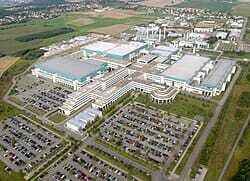
Image source: wikipedia.org
Understanding GlobalFoundries: Market Position and Business Model
GlobalFoundries has carved out a distinctive niche in the semiconductor manufacturing ecosystem by deliberately focusing on mature and specialized technology nodes rather than pursuing the most advanced manufacturing processes. This strategic decision, made when the company exited the leading-edge race in 2018, has defined its current market positioning and competitive strategy.
The company operates four major manufacturing facilities across three continents: Malta (New York) and Essex Junction (Vermont) in the United States, Dresden in Germany, and Singapore. As of late 2025, GlobalFoundries reported quarterly revenue of $1.688 billion with gross margins of 24.8% and operating margins of 11.6%, demonstrating stable financial performance in a competitive environment.
Revenue Distribution by End Market Segments
Smart Mobile Devices:        45% of total revenue
Home & Industrial IoT:       19% of total revenue
Automotive:                  18% of total revenue
Communications Infrastructure
  & Data Center:            18% of total revenue
This diversified revenue base provides GlobalFoundries with resilience against cyclical downturns in any single market segment. The company’s customer base includes industry leaders such as Qualcomm, AMD, NXP, Infineon, Bosch, and increasingly, Apple and SpaceX, reflecting the breadth of its technological capabilities and market reach.
Qualcomm - SWOT Analysis Report (2026)
www.deepresearchglobal.com/p/qualcomm-swot-analysis-report
www.deepresearchglobal.com/p/amd-swot-analysis
Strengths: Strategic Assets Driving Competitive Advantage
Geographic Diversification and Manufacturing Scale
GlobalFoundries’ manufacturing footprint represents a significant strategic asset in an era of increasing supply chain concerns and geopolitical tensions. The company’s facilities span multiple continents, providing customers with geographic redundancy and reducing concentration risk associated with single-location production.
Manufacturing Site
Location
Capacity (Annual)
Primary Technologies
Strategic Significance
Fab 8
Malta, New York
400,000 wafers
12nm to 65nm nodes
Largest US fab; critical for defense and automotive
Fab 9
Essex Junction, Vermont
200,000 wafers
180nm to 200nm
Specialized RF and power management
Fab 1
Dresden, Germany
1,000,000+ wafers (by 2028)
22nm to 130nm
European supply chain anchor; automotive focus
Fab 7
Singapore
1,500,000 wafers
40nm to 180nm
Asia-Pacific hub; high-volume production
This geographic distribution is particularly valuable as semiconductor supply chain diversification becomes a strategic imperative for customers and governments alike. The company’s expansion plans, including the $1.1 billion investment in Dresden, position it to capture growing demand in Europe’s automotive and industrial sectors.
Technology Platform Leadership in Specialized Nodes
While GlobalFoundries does not compete in sub-7nm leading-edge nodes, the company has established technological leadership in several specialized platforms that command premium pricing and serve critical applications:
FDX (Fully Depleted Silicon-On-Insulator) Platform
GlobalFoundries’ FDX technology, particularly the 22FDX process, offers unique advantages for low-power, high-performance applications. This platform enables full system-on-chip integration including digital, analog, and high-performance radio frequency components. The technology is particularly well-suited for AI edge computing, automotive electronics, and IoT devices where power efficiency is paramount.
Silicon Photonics Leadership
The acquisition of Advanced Micro Foundry in November 2025 transformed GlobalFoundries into the largest pure-play silicon photonics foundry globally. This strategic move positions the company to capitalize on the explosive growth of AI data centers, which require silicon photonics for high-speed optical interconnects. Management projects silicon photonics revenue to exceed $200 million in 2025, nearly double the previous year, with significant growth potential as AI infrastructure expands.
GaN (Gallium Nitride) Technology Development
GlobalFoundries’ licensing agreement with TSMC for gallium nitride technology represents a strategic acceleration of its power management portfolio. GaN semiconductors enable more efficient power conversion for data centers, industrial equipment, and electric vehicles. With products expected in late 2026, this positions GlobalFoundries to address the growing demand for energy-efficient power electronics.
Government Support and Strategic Partnerships
The company has secured substantial government backing, reflecting its strategic importance to national semiconductor capabilities:
US CHIPS Act Direct Funding:   $1.587 billion
New York State Green CHIPS:    $550+ million
German/EU Chips Act Support:   Substantial incentives
Total Investment Commitments:  $16 billion+ (over 10+ years)
This government support validates GlobalFoundries’ strategic importance and provides capital to fund expansion without excessive shareholder dilution. The funding is tied to specific capacity expansion and technology development milestones, ensuring alignment with national strategic objectives.
Beyond government partnerships, GlobalFoundries has established strategic relationships with major technology companies. The $16 billion expansion announcement in June 2025 included commitments from Apple, SpaceX, AMD, Qualcomm, NXP, and General Motors, demonstrating strong customer endorsement of the company’s roadmap.
Financial Stability and Cash Generation
GlobalFoundries has demonstrated improving financial performance with consistent positive cash flow generation:
Financial Metric
Q3 2025
Q2 2025
Q3 2024
Year-over-Year Change
Revenue
$1.688B
$1.688B
$1.739B
-3%
Gross Margin
24.8%
24.2%
23.8%
+100 bps
Operating Margin
11.6%
11.6%
10.6%
+100 bps
Operating Cash Flow
$595M
$431M
$375M
+59%
Free Cash Flow (Non-IFRS)
$451M
$277M
$216M
+109%
Cash & Marketable Securities
$4.2B
$4.1B
$4.5B
-7%
The improving margin profile reflects better product mix, operational efficiency gains, and pricing discipline. With over $4.2 billion in cash and marketable securities and minimal near-term debt maturities, GlobalFoundries maintains financial flexibility to fund growth investments and weather cyclical downturns.
Weaknesses: Structural Challenges and Competitive Disadvantages
Absence from Leading-Edge Node Competition
GlobalFoundries’ strategic decision to exit the race for leading-edge nodes (7nm and below) creates a fundamental limitation on its addressable market. While this decision reduced capital intensity and improved profitability, it excludes the company from the highest-growth segments of the semiconductor market, including advanced AI accelerators, high-performance computing processors, and flagship smartphone application processors.
The leading-edge foundry market is experiencing robust growth, with TSMC capturing 72% of the pure-foundry market through its advanced node leadership. This segment commands premium pricing and represents the technology frontier, areas where GlobalFoundries cannot compete directly.
Competitive Positioning by Technology Node
Leading-Edge (3nm-7nm):
  Primary Players: TSMC, Samsung
  GlobalFoundries Position: Not participating

Advanced Mature (12nm-28nm):
  Primary Players: TSMC, Samsung, GlobalFoundries, SMIC
  GlobalFoundries Position: Strong competitor

Mature/Specialty (40nm and above):
  Primary Players: GlobalFoundries, UMC, Tower, SMIC
  GlobalFoundries Position: Top-tier competitor
Smartphone Market Exposure and Cyclicality
Despite diversification efforts, smartphone-related revenue still represents 45% of GlobalFoundries’ total revenue. The smartphone market faces structural challenges including market saturation in developed economies, lengthening replacement cycles, and intense pricing pressure. This significant exposure creates earnings volatility as smartphone demand fluctuates with consumer confidence and macroeconomic conditions.
During Q2 and Q3 2025, the company reported cautious outlooks amid weak smartphone demand, particularly affecting its mobile device segment. While automotive and communications infrastructure segments showed strong year-over-year growth (both up double digits), the smartphone exposure remains a headwind for near-term growth.
Capital Intensity and Technology Investment Requirements
Semiconductor manufacturing is inherently capital-intensive, and GlobalFoundries faces ongoing requirements to maintain and upgrade facilities, develop new process technologies, and expand capacity. The company’s $16 billion investment commitment through the mid-2030s represents substantial capital deployment that must generate adequate returns to satisfy shareholders.
Investment Category
Estimated Allocation
Strategic Purpose
Manufacturing Capacity Expansion
$8-9 billion
New fabs and capacity additions in Malta and Dresden
Advanced Packaging
$3-4 billion
Heterogeneous integration capabilities
Technology Development
$3-4 billion
Silicon photonics, GaN, and FDX platforms
While government funding offsets a portion of these investments, GlobalFoundries must still deploy significant shareholder capital. The return on these investments depends on sustained demand and pricing discipline, factors not entirely within the company’s control.
Talent Competition and Technology Complexity
The semiconductor industry faces acute talent shortages, particularly for specialized roles in process engineering, advanced packaging, and emerging technologies like silicon photonics. GlobalFoundries competes for talent against better-resourced rivals (TSMC, Samsung, Intel) and technology giants (Apple, Nvidia, Google) who can offer higher compensation and perceived career advancement.
The integration of AI into semiconductor manufacturing, as evidenced by the recent Siemens collaboration, requires expertise at the intersection of AI/machine learning and semiconductor physics. This specialized skillset is particularly scarce, potentially constraining the pace of operational improvement and technology development.
Geographic Concentration in Geopolitically Sensitive Regions
While GlobalFoundries’ geographic diversification is a strength, its significant manufacturing presence in Singapore creates exposure to Asia-Pacific geopolitical dynamics. Approximately 40% of the company’s manufacturing capacity is located in Singapore, which, while politically stable, sits in a region of heightened geopolitical tension.
Any escalation in regional tensions, particularly regarding Taiwan and China, could disrupt supply chains, affect customer confidence, or trigger restrictions on technology transfer. This geographic risk requires ongoing management attention and contingency planning.
Opportunities: Growth Vectors and Market Tailwinds
AI Infrastructure Boom and Silicon Photonics Demand
The artificial intelligence revolution represents a transformative opportunity for GlobalFoundries, particularly through its silicon photonics capabilities. AI data centers require massive increases in bandwidth to support training and inference workloads, driving demand for optical interconnects based on silicon photonics technology.
Industry analysts project the AI semiconductor market will drive substantial growth through 2026 and beyond, with 93% of semiconductor leaders expecting revenue growth. GlobalFoundries’ silicon photonics platform addresses a critical bottleneck in AI infrastructure, positioning the company to capture value from this secular trend.
Silicon Photonics Market Opportunity
2025 GF Silicon Photonics Revenue:     ~$200 million
Market Growth Rate (projected):         30-40% annually
Key Applications:
  - AI data center interconnects
  - Telecommunications infrastructure
  - Autonomous vehicle sensors (LiDAR)
  - High-performance computing
The Advanced Micro Foundry acquisition transformed GlobalFoundries into the world’s largest pure-play silicon photonics foundry, providing scale advantages and a comprehensive technology portfolio. As hyperscale cloud providers and AI companies invest billions in infrastructure, silicon photonics becomes increasingly critical to system architecture.
Automotive Electrification and Advanced Driver Assistance Systems
The automotive industry transformation toward electrification and autonomous driving creates substantial semiconductor content growth. Modern electric vehicles contain 2-3 times the semiconductor content of traditional internal combustion vehicles, while advanced driver assistance systems (ADAS) and autonomous driving platforms require even more processing power, sensors, and connectivity.
GlobalFoundries’ automotive revenue has shown consistent year-over-year growth, representing approximately 16-18% of total revenue. The company’s technology platforms are well-suited for automotive applications requiring high reliability, functional safety certification, and long product lifecycles.
Automotive Semiconductor Application
Technology Node
GF Competitive Position
Growth Driver
Battery Management Systems
40nm-180nm
Strong
EV adoption
Power Electronics (Inverters)
GaN on Silicon
Developing
Efficiency requirements
ADAS Sensors and Processing
22FDX, 12nm
Very Strong
Safety regulations
Infotainment and Connectivity
22FDX, 28nm
Strong
Consumer expectations
Vehicle-to-Everything (V2X)
RF-SOI, 22FDX
Strong
Connected vehicles
The company’s long-term agreements with automotive leaders including Infineon, NXP, Bosch, and Aumovio provide revenue visibility and support capacity investment decisions. The Dresden facility expansion specifically targets European automotive customers, positioning GlobalFoundries to serve this market with local supply chain resilience.
5G and 6G Wireless Infrastructure Buildout
The ongoing 5G network deployment and early development of 6G technologies create sustained demand for radio frequency (RF) semiconductors, where GlobalFoundries maintains technological leadership. The company’s RF-SOI and GaN technologies enable the complex signal processing, power management, and thermal performance required for wireless infrastructure.
GlobalFoundries’ communications infrastructure and data center segment reported 32% year-over-year revenue growth to $175 million in Q3 2025, reflecting robust infrastructure investment. The company’s technology roadmap includes enhanced RF performance and integration capabilities to support emerging 6G requirements.
Wireless Infrastructure Technology Requirements
Massive MIMO Base Stations:High-power RF amplifiers (GaN)
Small Cell Networks:       Integrated RF transceivers (RF-SOI)
Satellite Communications:  High-frequency millimeter-wave chips
Edge Computing Nodes:      Low-power integrated SoCs (FDX)
Defense and Aerospace Modernization
GlobalFoundries’ domestic manufacturing capabilities in the United States position the company uniquely for defense and aerospace applications, which require trusted supply chains and often mandate domestic production. The company has been designated a trusted foundry for US government applications, opening access to defense electronics markets.
Defense modernization programs emphasize electronic warfare, radar systems, secure communications, and advanced sensors, all of which require sophisticated semiconductor technologies. GlobalFoundries’ RF capabilities, radiation-hardened processes, and secure supply chains align well with these requirements.
The company’s collaboration with major technology companies including SpaceX for the expansion plan suggests growing interest in its capabilities for space and defense applications, where reliability and performance are paramount.
Internet of Things and Edge Computing Proliferation
The proliferation of connected devices across industrial, consumer, and infrastructure applications creates sustained demand for power-efficient, cost-effective semiconductors. Industry analysts project billions of new IoT devices will be deployed through 2026 and beyond, spanning smart cities, industrial automation, healthcare monitoring, and consumer electronics.
GlobalFoundries’ FDX platform offers particular advantages for battery-powered IoT devices, providing the power efficiency needed for extended operation. The platform’s integration capabilities enable complete system-on-chip designs that reduce bill-of-materials costs, a critical consideration for price-sensitive IoT applications.
IoT Semiconductor Technology Trends
Ultra-Low Power Operation: FDX platform leadership position
Wireless Connectivity: RF-SOI and integrated transceivers
Edge AI Processing: FDX with neural network acceleration
Security Features: Hardware-based secure elements
Environmental Sensors: Integrated MEMS and CMOS
The company’s partnerships with connectivity specialists like Silicon Labs for wireless IoT solutions demonstrate its commitment to capturing this market opportunity through ecosystem collaboration.
Threats: External Risks and Competitive Pressures
Intensifying Chinese Competition and Overcapacity
Chinese semiconductor manufacturers, led by SMIC (Semiconductor Manufacturing International Corporation), represent an increasingly formidable competitive threat. Despite US export controls restricting access to advanced manufacturing equipment, Chinese foundries continue to expand capacity in mature nodes where GlobalFoundries competes.
SMIC’s government-supported expansion and aggressive pricing pose a direct challenge to GlobalFoundries’ market share, particularly in price-sensitive applications. Chinese foundries benefit from substantial state subsidies, allowing them to undercut competitors on price while maintaining profitability through government support.
Competitive Factor
GlobalFoundries
SMIC (China)
UMC (Taiwan)
Government Support
CHIPS Act funding
Massive subsidies
Moderate support
Technology Access
Full access to Western tech
Restricted by export controls
Full access
Capacity Expansion
Measured, capital-disciplined
Aggressive, state-backed
Moderate expansion
Geographic Reach
Global with US/EU focus
China-centric
Asia-Pacific focus
Pricing Flexibility
Market-based
Below-market with subsidies
Market-based
The risk of global overcapacity in mature nodes could pressure pricing and margins, potentially requiring consolidation or capacity rationalization across the industry. GlobalFoundries must maintain technological differentiation and customer relationships to command premium pricing despite competitive pressure.
Geopolitical Tensions and Trade Restrictions
The escalating technological competition between the United States and China creates ongoing uncertainty for semiconductor manufacturers. Export controls, import restrictions, tariffs, and technology transfer limitations can disrupt established supply chains and customer relationships.
For GlobalFoundries, geopolitical risks manifest in several ways:
Direct Restrictions: The company’s operations in China and relationships with Chinese customers could face restrictions, limiting market access.
Customer Impact: Technology controls affecting GlobalFoundries’ customers (particularly Chinese smartphone and electronics manufacturers) reduce their demand for foundry services.
Supply Chain Disruption: Raw materials and chemicals sourced from China could become subject to restrictions, requiring supply chain reconfiguration.
Talent Mobility: Restrictions on researcher and engineer mobility between countries could constrain technology development and collaboration.
The company’s recent partnership with a Chinese foundry for automotive chips demonstrates efforts to navigate this complex environment, but such relationships may face scrutiny or restrictions as geopolitical tensions evolve.
Cyclical Demand and Economic Sensitivity
The semiconductor industry remains cyclical, with demand highly sensitive to consumer spending, business investment, and macroeconomic conditions. GlobalFoundries’ exposure to consumer-oriented end markets (smartphones representing 45% of revenue) creates vulnerability to demand fluctuations.
Economic forecasts for 2026 show mixed signals, with potential recession risks in developed markets potentially affecting consumer electronics demand. While automotive and infrastructure segments show resilience, a broad-based economic downturn would affect all end markets simultaneously.
Cyclical Risk Factors by End Market
Smartphones (45%): High cyclicality; replacement cycle sensitivity
Automotive (18%): Moderate cyclicality; inventory adjustment risks
IoT (19%): Moderate cyclicality; project-based lumpiness
Communications (18%): Low to moderate; infrastructure investment driven
GlobalFoundries’ capital-intensive business model means that revenue declines flow through to profitability rapidly, as fixed costs remain constant. The company must maintain pricing discipline and cost control to preserve margins during cyclical downturns.
Technology Disruption and Platform Shifts
Rapid technology evolution in semiconductor architectures and manufacturing techniques creates both opportunities and threats. The emergence of chiplet-based designs, 3D stacking, and heterogeneous integration could disrupt traditional foundry business models.
Chiplet adoption in IoT and automotive is expected to expand significantly in 2026, potentially changing how customers source semiconductor manufacturing. Rather than fabless companies designing complete system-on-chip products manufactured by a single foundry, chiplet approaches enable mixing components from multiple sources, potentially fragmenting foundry revenues.
GlobalFoundries’ $3 billion investment in advanced packaging and heterogeneous integration capabilities addresses this threat proactively. However, established IDMs (integrated device manufacturers) and OSAT (outsourced assembly and test) companies also compete in advanced packaging, creating a complex competitive dynamic.
Customer Concentration and Dependence
While GlobalFoundries serves diverse end markets, revenue concentration among top customers creates business risk. Loss of a major customer or significant volume reduction would materially impact financial performance. The company’s relationships with Qualcomm, AMD, NXP, and Infineon represent significant revenue contributions.
Fabless semiconductor companies continually evaluate foundry partners based on technology capabilities, capacity availability, pricing, and strategic alignment. A major customer’s decision to shift volume to a competitor (whether TSMC, Samsung, UMC, or SMIC) for cost or technology reasons could significantly affect GlobalFoundries’ capacity utilization and profitability.
The company mitigates this risk through long-term supply agreements, technology co-development partnerships, and differentiated platform offerings. However, customer concentration remains an inherent business risk requiring active management.
Environmental and Regulatory Compliance Costs
Semiconductor manufacturing is energy-intensive and uses substantial water and chemicals, creating environmental compliance obligations and potential liability. Increasingly stringent environmental regulations in the United States and Europe require ongoing investment in emissions reduction, water recycling, and chemical management.
The $550+ million in New York State Green CHIPS funding specifically targets environmentally sustainable manufacturing practices, but compliance costs extend beyond direct government support. Meeting customer sustainability requirements, reducing Scope 1, 2, and 3 emissions, and transitioning to renewable energy all require capital investment and operational changes.
GlobalFoundries’ collaboration with Siemens on AI-driven manufacturing includes sustainability optimization as a key objective, demonstrating the company’s proactive approach. However, the pace and cost of environmental regulation remain uncertain, potentially affecting competitiveness if requirements diverge significantly across geographies.
Strategic Implications for Investors
Investment Thesis and Risk-Reward Profile
GlobalFoundries presents a distinctive investment profile characterized by stable mature-node manufacturing, exposure to secular growth trends (AI infrastructure, automotive electrification, wireless connectivity), and meaningful but manageable competitive and geopolitical risks.
Investment Positives:
✓ Diversified geographic manufacturing reducing supply chain risk
✓ Differentiated technology platforms (FDX, silicon photonics, GaN)
✓ Strong customer relationships with technology leaders
✓ Government support validating strategic importance
✓ Exposure to secular growth trends beyond consumer electronics
✓ Improving financial performance and cash generation
Investment Concerns:
✗ Significant smartphone exposure (45% of revenue)
✗ Absence from highest-growth leading-edge segments
✗ Chinese competition and overcapacity risk
✗ Capital intensity requiring ongoing investment
✗ Geopolitical exposure through Singapore operations
For investors evaluating GlobalFoundries, the key consideration is whether the company’s specialized positioning, geographic diversification, and technology differentiation justify valuation relative to cyclical and competitive risks.
Comparison with Foundry Competitors
Understanding GlobalFoundries’ position requires context within the broader foundry competitive landscape:
Foundry
2025 Market Share
Strategic Focus
Key Differentiators
TSMC
68-72%
Leading-edge leadership
3nm and 2nm technology; scale advantages
Samsung
8-11%
Leading-edge and memory
Vertical integration; mobile ecosystem
GlobalFoundries
5-6%
Mature and specialty nodes
Geographic diversity; differentiated platforms
UMC
6-7%
Cost-effective mature nodes
China market access; efficiency focus
SMIC
5-6%
Chinese ecosystem focus
Government support; domestic market
GlobalFoundries occupies a middle position between scale leaders (TSMC, Samsung) and regional specialists (Tower, Hua Hong, Vanguard). This positioning requires maintaining technological differentiation while competing on cost and service against both larger and smaller rivals.
Financial Outlook and Valuation Considerations
GlobalFoundries provided Q4 2025 guidance projecting revenue of approximately $1.8 billion with gross margins around 28.5%, indicating continued margin expansion from improved product mix and operational leverage.
Key Financial Metrics and Projections
Q4 2025 Guidance:
  Revenue: $1.8 billion ± $25 million
  Gross Margin: 28.5% ± 100 basis points (Non-IFRS)
  Operating Margin: 16.8% ± 170 basis points (Non-IFRS)

Full-Year 2025 Estimated Performance:
  Revenue: ~$6.8-6.9 billion
  Gross Margin: 25-26% (Non-IFRS)
  Free Cash Flow: $1.4-1.6 billion (estimated)
The company’s improving margins reflect pricing discipline, favorable product mix toward higher-value platforms (FDX, silicon photonics, RF), and operational efficiency gains from AI-driven manufacturing optimization.
For investors, valuation assessment should consider:
Multiple on earnings: GlobalFoundries trades at a discount to leading-edge foundries, reflecting lower growth prospects but also lower technology risk.
Free cash flow yield: The company’s improving cash generation provides return of capital potential through dividends or share repurchases.
Growth trajectory: Revenue growth will likely track in the mid-single digits, driven by content growth in automotive, communications infrastructure, and silicon photonics offsetting smartphone headwinds.
Cyclical positioning: Current positioning in the semiconductor cycle affects near-term performance, with 2026 expected to see moderate recovery from the 2023-2024 downturn.
Key Monitoring Metrics for Investors
Investors tracking GlobalFoundries should focus on these key performance indicators:
Metric Category
Specific Metrics
Strategic Significance
Revenue Mix
Automotive, Communications, IoT, Smartphone proportions
Diversification progress away from smartphones
Platform Revenue
FDX, silicon photonics, GaN contribution
Technology differentiation value capture
Geographic Mix
US, Europe, Asia revenue split
Supply chain positioning and geopolitical risk
Customer Concentration
Top 10 customer percentage
Business risk and pricing power
Capacity Utilization
Fab loading rates by facility
Demand strength and operational efficiency
Technology Roadmap
New platform introductions and customer adoption
Competitive positioning maintenance
Capital Allocation
Capex as % revenue, R&D investment
Balance between growth and returns
My Final Thoughts
GlobalFoundries has successfully carved out a profitable niche in the semiconductor foundry industry through strategic focus on mature and specialty nodes, geographic diversification, and differentiated technology platforms. The company is positioned to benefit from secular trends in automotive electrification, AI infrastructure, and wireless connectivity, while managing risks from Chinese competition, cyclical demand, and geopolitical tensions.
For investors, GlobalFoundries represents a play on the semiconductor industry’s breadth rather than its cutting edge, offering exposure to essential chips powering everyday devices, vehicles, and infrastructure. The company’s strengths in specialized technologies (FDX, silicon photonics, GaN), geographic diversity, and improving financial performance must be weighed against smartphone market exposure, capital intensity, and competitive pressures.
This SWOT analysis reveals a company in transition toward higher-value applications and technologies, supported by substantial government backing and customer commitments. Success depends on execution of the capacity expansion program, technology platform development, and maintaining pricing discipline amid competitive pressures.
As the global semiconductor supply chain continues reshoring and diversification through 2026 and beyond, GlobalFoundries’ geographic footprint and trusted foundry status position it to capture value from this strategic shift. The company’s performance will reflect both its own execution and broader industry dynamics, making it an important bellwether for the mature-node foundry segment.
Investors should monitor quarterly results for evidence of margin expansion, silicon photonics revenue growth, automotive market share gains, and successful capacity additions.
The company’s ability to maintain technological differentiation while competing on cost will determine whether it can sustain premium valuations relative to pure commodity foundries. In the complex semiconductor ecosystem, GlobalFoundries has staked out defensible territory, but constant adaptation remains essential for long-term success.
Disclaimer: This analysis is for informational purposes only and should not be construed as investment advice. Investors should conduct their own due diligence and consult with financial advisors before making investment decisions.