

Dear Investor, Welcome to Deep Research Global.
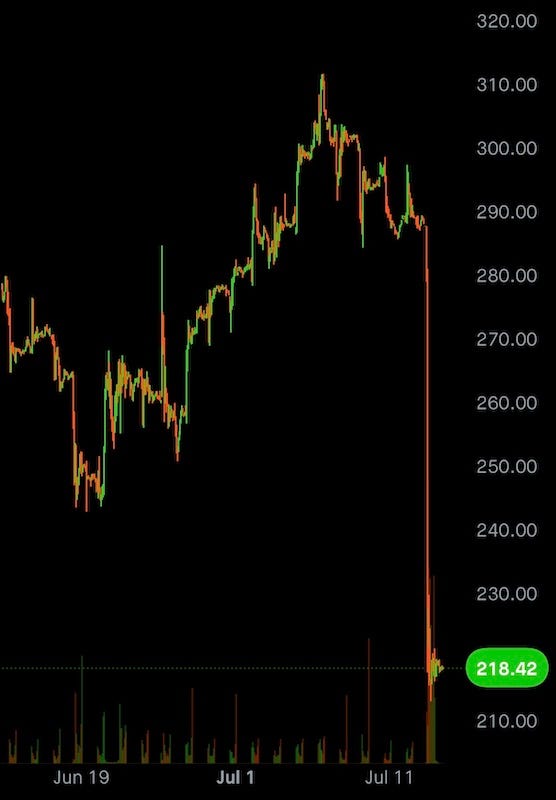
On July 14, 2026, shares of International Business Machines (IBM) suffered the worst single-day collapse in the company’s 115-year listed history.
The stock plunged roughly 25% before recovering slightly by the close, with an intraday move that surpassed even Black Monday, when Big Blue fell 23.7% on October 19, 1987.
The move erased about $69 billion in market value in a single session, one of the largest single-day dollar wipeouts a Dow component has ever absorbed outside of a systemic crash.
For a company routinely described as a defensive tech name, this was an ambush.
And unlike 1987, there was no macro crash to blame. The catalyst was internal, specific, and worded in a way Wall Street rarely forgets: CEO Arvind Krishna said IBM “faltered.”
Recommended - Read Full Reports

Read All Reports
Disclaimer: This analysis is for informational & educational purposes only and should not be construed as investment advice. Investors should conduct their own due diligence before making investment decisions. Past performance does not guarantee future results.
What Actually Happened: The Pre-Earnings Warning
Before the market opened on Tuesday, IBM did something it almost never does. It released preliminary Q2 numbers a full week ahead of the scheduled July 22 report.
Preliminary Q2 revenue came in at $17.2 billion, up just 1%, versus the $17.86 billion consensus. Adjusted EPS was $2.93 against a $3.01 estimate, and GAAP EPS landed at $2.27.
IBM Q2 2026 (Preliminary) — Snapshot
- Revenue: $17.2B  (est. $17.86B)  → miss of ~$660M
- Non-GAAP EPS: $2.93  (est. $3.01)
- GAAP EPS: $2.27
- YoY revenue growth: ~1%
- Segment: Software +5%, Red Hat +11%, Consulting ~flat
- Full report scheduled: July 22, 2026
The scale of the reaction was driven less by the miss itself and more by the reason for it. A shortfall of roughly $660 million on revenue does not, on its own, justify erasing a market cap larger than the entire enterprise value of Kraft Heinz.
Why the Sell-Off Was So Violent
In his letter, Krishna explained that in the final weeks of June, enterprise clients redirected capital spending away from software and toward “servers, storage, and memory purchases to secure supply-constrained infrastructure ahead of expected price increases.”
Put plainly, customers pulled dollars out of software renewals and consulting engagements and shoved them at memory chips and AI-ready hardware.
That’s not a temporary hiccup but a budget reallocation that could persist as long as the AI infrastructure buildout continues.
Krishna also acknowledged execution problems.
Numerous large deals failed to close on the expected timelines, which he called the “majority of our shortfall.” Language like “faltered” and “did not adapt and move quickly enough” from a Fortune 50 CEO is rare, and the market treated it as such.
The 1987 Comparison
Since IBM’s public trading records begin, Tuesday’s decline is its worst on record. The previous benchmark was Black Monday, when the Dow fell 22.6% and IBM lost 23.7% in a systemic panic that spread across every global exchange.
The 2026 fall is worse in percentage terms and vastly worse in dollar terms. What makes it more striking is context.
In 1987, IBM was a part of the “everything collapse”. In 2026, IBM collapsed while the Nasdaq 100 was up 1.08% on a benign inflation print. This was not a market-wide contagion but an IBM event, with clear spillover.
Then vs Now
- Oct 19, 1987: IBM −23.7%, Dow −22.6% (systemic crash)
- Jul 14, 2026: IBM ≈ −25%, Nasdaq 100 +1.08% (idiosyncratic)
- 2026 dollar loss (IBM): ~$69 billion in a single session
The AI Displacement Question: Is Software Being Cannibalized?
The most uncomfortable read of the miss is what it says about enterprise software spending in an AI capex boom.
Memory suppliers such as Micron and SK Hynix have been aggressive beneficiaries of the AI hardware cycle. When CFOs face fixed IT budgets, every dollar spent on GPUs, storage arrays, or high-bandwidth memory is a dollar not spent on new software seats or consulting hours.


Krishna partly disagreed. He told CNBC’s Sara Eisen that customer caution around Anthropic’s new model, “Mythos,” was pushing buyers to