

Welcome to Deep Research Global - The institutional-grade investment analysis newsletter, built exclusively for savvy investors.
The insights that move investment decision, before the crowd catches on. Become a paying member & unlock full access now.
As a paid member you get access to:
Daily - Deep-dive fundamental analysis reports & investment insights
Weekly - Earnings analysis of key releases
One subscription. Unlock full archive - 100s of stock/company analysis reports (updated regularly)
In case you missed it, here are the latest analysis:
List of All Reports - Check It Out
Executive TL;DR
Snowflake (SNOW)’s product revenue growth has now climbed for three straight quarters, reaching 37% year over year in Q2 FY2027, and management raised full-year FY2027 product revenue guidance to $6.07 billion (36% growth), up from $5.84 billion previously.
The demand engine is broadening. Net revenue retention ticked up to 126%, remaining performance obligations reached $9.0 billion (up 30% year over year), and the count of customers generating more than $1 million in trailing product revenue grew 27% to 828.
AI is now a measurable growth driver. CEO Sridhar Ramaswamy told investors that AI products produced roughly half of the quarter’s growth acceleration, with the core data platform delivering the rest.
Profitability keeps improving on adjusted metrics (15.3% non-GAAP operating margin, 23% guided full-year adjusted free cash flow margin), but the GAAP operating loss was still $263 million, and quarterly cash flow conversion remains back-half weighted.
The stock carries a market value of roughly $106 billion, or about 17 to 18 times guided FY2027 product revenue. The central debate from here: how durable this AI-driven re-acceleration proves against Databricks and the hyperscalers.
Here’s what you get in this analysis:
Snowflake Company Profile: Key Facts Snapshot
Business Model Overview
Q2 FY2027 Earnings: Full Teardown
Revenue and Growth Quality
Guidance: Raised Across the Board
Margins and Earnings Quality
Cash Flow Mechanics
Balance Sheet Health
Revenue Analysis: Where Growth Actually Comes From
The Consumption Engine in Numbers
Cohort Economics: NRR and Large Customers
The RPO Deceleration Debate
Platform and Product Teardown
Data Warehousing and Analytics: The Cash Cow
Data Engineering and Snowpark
AI and Machine Learning: Cortex, Snowflake Intelligence, and Agents
Snowflake Postgres and the Operational Data Push
Open Formats: Iceberg, Polaris, and Interoperability
Applications, Marketplace, and Collaboration
Strategic Context
The Ramaswamy Era
Enterprise AI Spending Context
Partnerships and Ecosystem
Competitive Arena
Snowflake vs. Databricks
Snowflake vs. BigQuery and Redshift
Snowflake vs. Microsoft Fabric
Open-Source Challengers
From Optimization Trough to AI Re-acceleration: The Growth Cycle in Context
Why This Acceleration Looks Different
Reading Snowflake’s Non-GAAP Metrics and the EPS Trajectory
Security, Sovereignty, and the Quiet Demand Drivers
5 Questions That Will Define the Next Two Quarters
Valuation Framework
Key Risks
Catalysts to Watch
Latest Analyst Price Targets
How to Frame Position Sizing on SNOW
My Final Thoughts
Official Sources and Data
Disclaimer: This analysis is for informational & educational purposes only and should not be construed as investment advice. Investors should conduct their own due diligence before making investment decisions. Past performance does not guarantee future results.
Introduction
Growth almost always fades as revenue bases get bigger, but Snowflake’s product revenue growth has moved in the opposite direction for three consecutive quarters: 30%, 34%, then 37%.
Management attributes roughly half of the latest acceleration to AI products and half to the core data platform, which reframes the entire Snowflake debate. The question has shifted from “how quickly does cloud data warehousing mature” to “how large is the enterprise AI data opportunity, and who captures it.”
With a market value north of $100 billion and a forward earnings multiple deep into triple digits, the margin for error is thin.
This deep-dive analysis breaks down the numbers, mechanics of the business model behind them, competitive outlook, valuation frameworks, the specific catalysts, risks & more.
Let’s begin.
Snowflake Company Profile: Key Facts Snapshot
Company:            Snowflake Inc.
Ticker:             SNOW (New York Stock Exchange)
Headquarters:       Bozeman, Montana, with major offices in Menlo Park, California
Founded:            2012, by Benoit Dageville, Thierry Cruanes, and Marcin Zukowski
IPO:                September 2020, priced at $120 per share, the largest software IPO of its era
CEO:                Sridhar Ramaswamy (in the role since February 2024)
CFO:                Brian Robins
Fiscal calendar:    Fiscal year ends January 31 (the current reporting year is FY2027)
Latest report:      Q2 FY2027, quarter ended July 31, 2026, reported September 2, 2026
Market value:       Roughly $106 billion as of early September 2026
Reporting segments: One reportable segment, the Data Cloud platform
Customer base:      829 Forbes Global 2000 members; 828 customers above $1M in
                    trailing 12-month product revenue
Snowflake sells a single thing: a cloud-hosted data platform that lets organizations store, process, share, and build on their data. Customers use it for data warehousing, data engineering, data science, AI application development, and secure data collaboration.
Business Model Overview
Consumption, Not Seats
Most enterprise software companies sell subscriptions priced per user. Snowflake does something fundamentally different: it charges for what customers actually use.
Customers buy compute “credits,” storage, and data transfer. Revenue gets recognized as that consumption happens, not when a contract is signed.
Product revenue, which captures this consumption, made up about 96% of total revenue in recent quarters, with professional services contributing the remainder.
How a dollar of Snowflake revenue is born:
  1. A customer runs a query, trains a model, or stores data
  2. Snowflake meters the compute (credits), storage, and transfer used
  3. Product revenue is recognized as consumption occurs
  4. Prepaid "capacity" contracts lock in commitments up front
     and accumulate as remaining performance obligations (RPO)
This model cuts both ways, and the history proves it.
When customers optimized their cloud spend in 2023 and 2024, Snowflake’s growth decelerated hard even though churn stayed low. When AI workloads started consuming serious compute in FY2027, growth re-accelerated just as mechanically.
For investors, this means quarterly product revenue is a purer demand signal than it’s at subscription peers.
There’s no “pull-forward” of multi-year deals into current-quarter revenue; the number reflects what customers actually burned.
The Architecture That Built the Franchise
Snowflake’s original technical breakthrough was separating storage from compute in the cloud. Customers can scale each independently, which legacy on-premise warehouses never allowed.
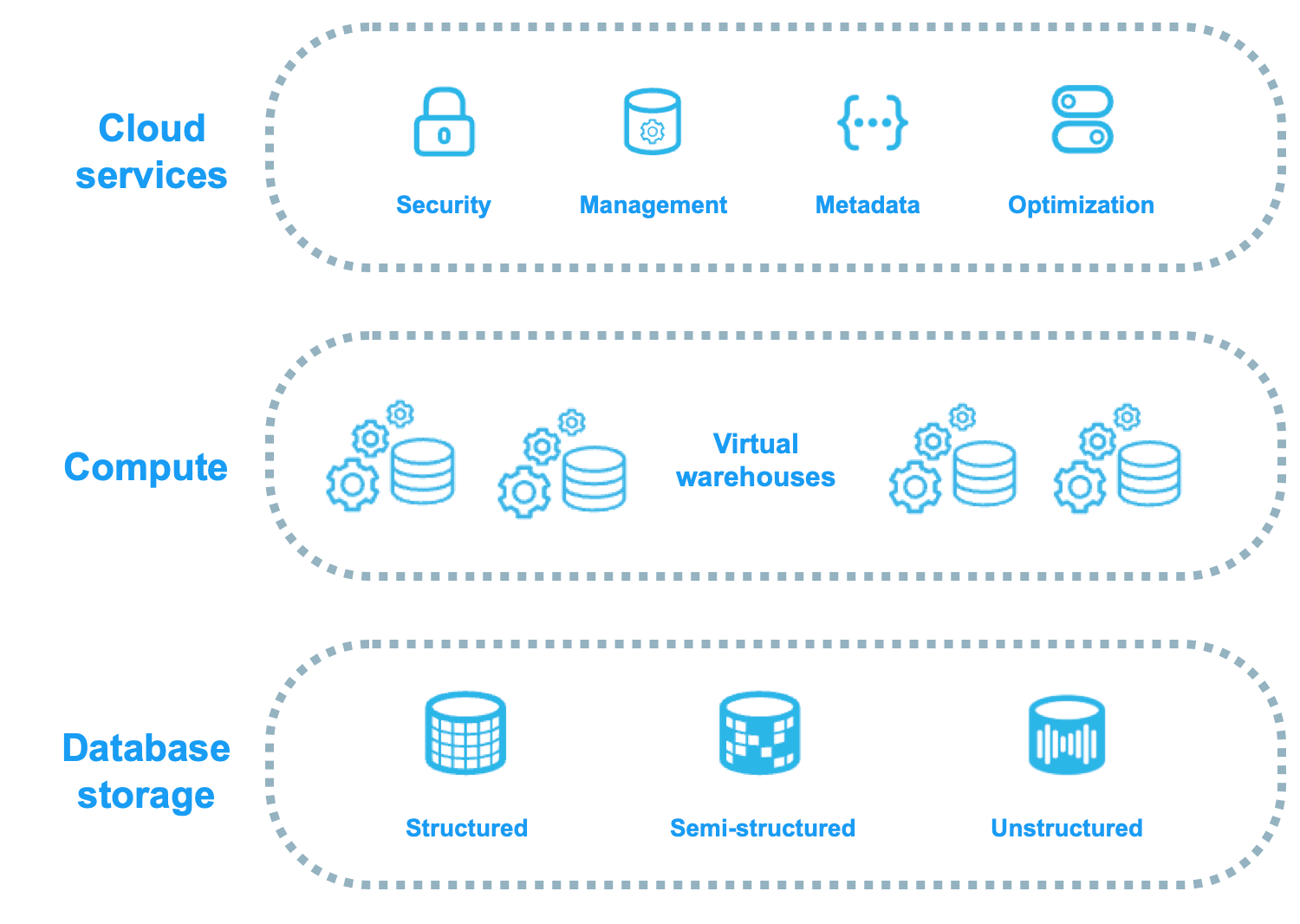
The platform runs as three loosely coupled layers: a centralized storage layer, a layer of independent compute clusters called virtual warehouses, and a cloud services layer that handles authentication, metadata, optimization, and security.
Snowflake's three-layer architecture:
  +---------------------------------------------+
  |  Cloud services (auth, metadata, security)  |
  +---------------------------------------------+
  |  Compute: independent virtual warehouses,   |
  |  each workload isolated, scale up or down   |
  +---------------------------------------------+
  |  Storage: centralized, compressed,          |
  |  cloud object storage underneath            |
  +---------------------------------------------+
Two strategic consequences flow from this design.
Snowflake runs on Amazon Web Services, Microsoft Azure, and Google Cloud, so customers can keep data near their existing cloud estate or span multiple clouds under one governance model.
Identical data can be shared across regions and clouds without copying, which feeds the network effects discussed below.
Platform Economics and Pricing Power
The non-GAAP product gross margin guide for FY2027 sits at 74%, and Q2 came in at 74.7%.
That’s a healthy software gross margin, though it sits below pure subscription peers because cloud infrastructure costs from AWS, Azure, and Google Cloud flow through cost of revenue.
Management trimmed the full-year product gross margin outlook modestly, a signal worth watching.
AI and GPU-heavy workloads carry higher infrastructure costs, and open table formats like Apache Iceberg change storage economics. Growth is being bought partly with margin mix, a trade that makes sense while demand accelerates.
Switching costs remain the quiet moat.
Once a company’s governed data, pipelines, and downstream applications live on Snowflake, migrating means rewriting pipelines and retraining teams. Data gravity is real, and it shows up in a net revenue retention rate of 126%.
Marketplace and Network Effects
Snowflake’s platform becomes more valuable as more organizations join it, which is rare in infrastructure software.
The Snowflake Marketplace lets data providers publish live datasets and applications that consumers can access instantly, without FTP drops or API integrations. Every new listing makes the platform stickier for buyers, and every new buyer makes the platform more attractive for sellers.
Data clean rooms extend this to privacy-sensitive collaboration between enterprises, a growing advertising and financial services use case.
Network effect flywheel:
  more data providers publish --> more consumers join
  more consumers join          --> more providers publish
  both sides consume compute   --> product revenue compounds
Monetization here is indirect but powerful: marketplace usage drives compute consumption, and shared data tends to stay inside Snowflake’s governance perimeter rather than leaking to rival platforms.