

Dear Investor, Welcome to Deep Research Global.
The AI hardware race just got one of its most consequential launches of the year.
Advanced Micro Devices (AMD) uses the timing of its upcoming Advancing AI 2026 keynote to unveil Helios, its first fully integrated rack-scale AI system, and simultaneously confirmed that Microsoft Azure will deploy it at scale.
Microsoft (MSFT) joins Meta (META), OpenAI, and Oracle (ORCL) in the Helios customer roster, giving AMD an unusually deep bench of hyperscale buyers before a single production rack has shipped.
For investors watching the data center silicon story, this is no longer a question of whether AMD can pressure Nvidia (NVDA) at the accelerator level. It’s now a contest with different economics and a very different partner list.
Let’s analyze the strategic angles from an investor’s point of view.
Recommended - Read Full Reports


Read All Reports
Disclaimer: This analysis is for informational & educational purposes only and should not be construed as investment advice. Investors should conduct their own due diligence before making investment decisions. Past performance does not guarantee future results.
What Actually Happened on July 20?
Microsoft announced to “ramp AMD Helios at scale on Azure” to power frontier-model inference for both its own services and external AI customers, per the joint announcement from Santa Clara.
Shipments to Microsoft and other named customers are slated to begin in the second half of 2026. That’s the same window guided at CES earlier this year, so there is no schedule slippage baked into this deal.
Announcement date: July 20, 2026
Product: AMD Helios Rackscale Solution
Silicon: MI455X GPUs + 6th Gen EPYC "Venice" CPUs + Pensando "Vulcano" NICs
First shipments: 2H 2026
Named customers to date: Microsoft, Meta, OpenAI, Oracle
The expansion goes beyond GPUs.
Azure is also adding two new virtual machine families, HDv2 for agentic AI and HXv2 for semiconductor design, both built on the Venice EPYC processors. Pensando DPUs are being woven deeper into Azure Boost networking.
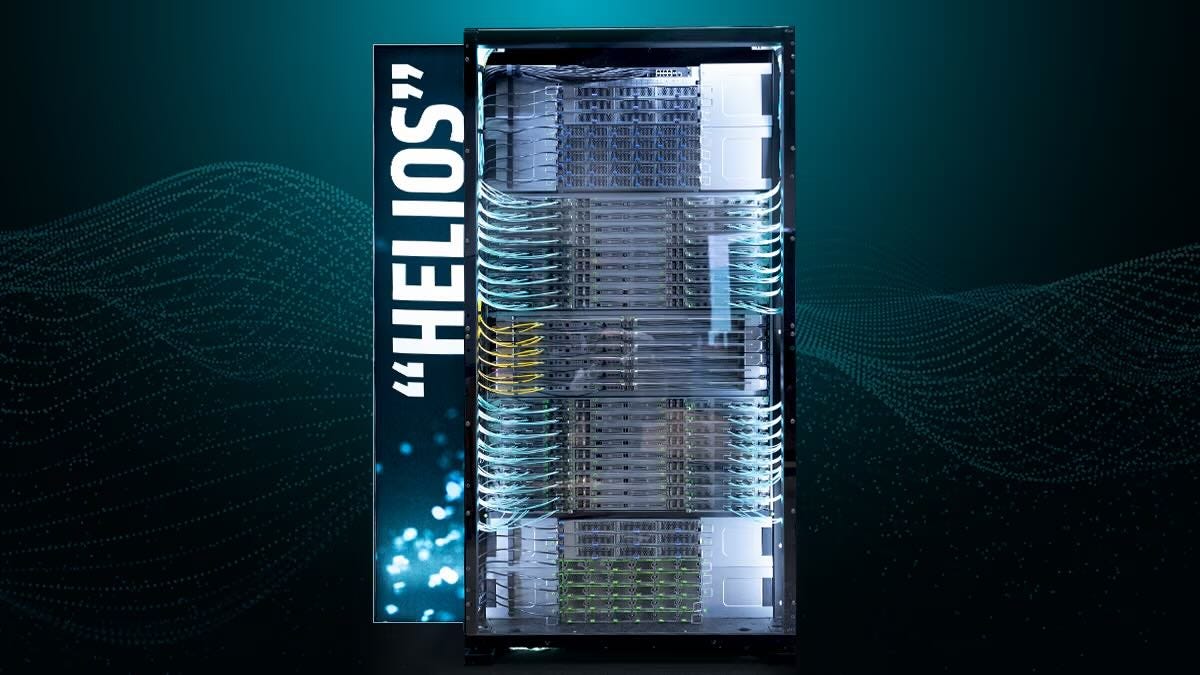
Inside the Helios Rack
The engineering specs are also one of the reasons what make this launch consequential.
A single Helios rack integrates 72 Instinct MI455X GPUs into a double-wide OCP Open Rack Wide chassis, sharing a common power hub and liquid-cooling loop.
Each MI455X carries 432 GB of HBM4 memory, pushing rack-level memory capacity to a figure that dwarfs prior generations.
AMD Helios Rack, key specs
GPUs per rack:            72 x Instinct MI455X
FP4 compute:              2.9 exaFLOPS
FP8 compute:              1.4 exaFLOPS
HBM4 memory (per rack):   31 TB
Per-GPU bandwidth:        19.6 TB/s
Scale-up bandwidth:       260 TB/s (UALink over Ethernet)
Scale-out bandwidth:      43 TB/s (Ultra Ethernet)
Also, the design deliberately leans on open standards.
UALink handles GPU-to-GPU scale-up, Ultra Ethernet handles cross-rack scale-out, and the mechanical chassis follows the OCP Open Rack Wide specification that